
VA Claim Denied With a Nexus Letter? Here’s Why & What to Do Next
Many veterans put significant time, effort, and money into obtaining a nexus letter, only to have their VA claim denied anyway.
That outcome is frustrating and confusing, especially when it feels like the VA barely addressed the nexus letter or instead relied on a flawed C&P exam.
It often leaves veterans wondering whether nexus letters actually help, whether the examiner’s opinion is all that matters, or whether paying for one was worth it at all.
The reality is more nuanced. A strong nexus letter is one of the most valuable pieces of evidence you can submit, but it is not a guaranteed win and does not automatically override a VA examiner’s opinion.
In many cases, the issue isn’t that the nexus letter was rejected, but that it was given little weight or overshadowed by a C&P exam.
In this guide, you’ll learn why VA claims are denied even with a nexus letter, how the VA weighs private medical opinions against C&P exams, and what to do next based on why your claim was denied.
Why the VA Denies Claims Even With a Nexus Letter
If your claim was denied even though you submitted a nexus letter, it usually comes down to how the VA weighed the medical evidence, not because you did something wrong.
In most cases, the VA either relied more heavily on a C&P exam, found the medical explanation lacking, or failed to fully address your letter.
📊 We Reviewed 50 VA Claims Where Private Nexus Letters Were Submitted
We reviewed 50 recent Board of Veterans’ Appeals decisions involving private nexus letters, these denial patterns appeared most often at the VA regional office level:
- ~45% – VA favored a VA examiner’s opinion over a private nexus letter
- ~30% – Private nexus letters were discounted due to inadequate medical rationale
- ~15% – Nexus letters were not meaningfully addressed in the decision
- ~10% – Clear pre-decisional duty-to-assist errors by the VA
In many cases, denial had less to do with whether a nexus letter was submitted, and more to do with how it was written, compared to other medical opinions, or explained in the decision.
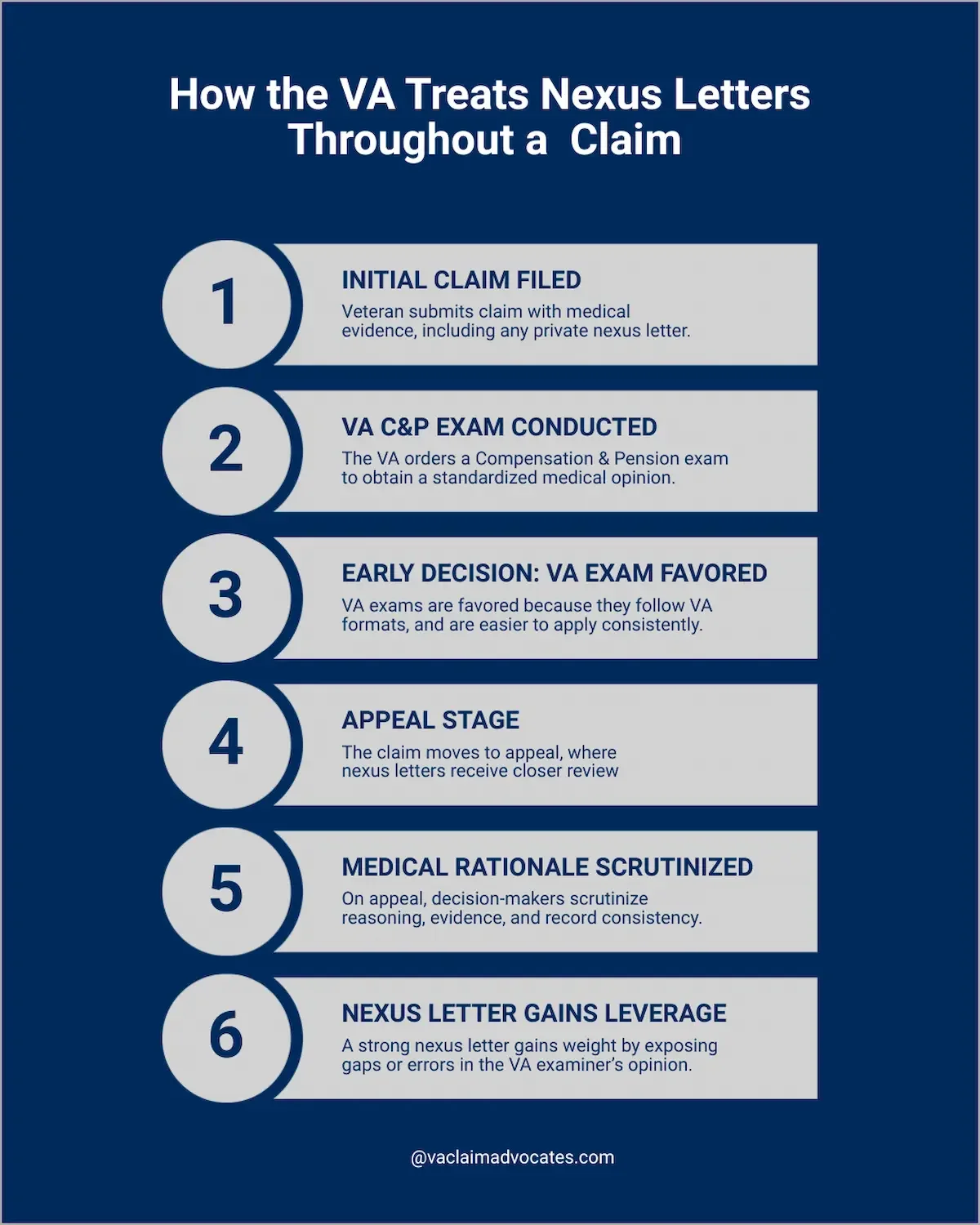
Why C&P Exams Carry More Weight Early On
VA examiner opinions are often given more weight in early VA decisions. However, this is usually not because a private nexus letter is wrong or unqualified.
Raters handle a high volume of claims using structured criteria, and VA examiner reports are designed to fit neatly within that system.
Some claims are complex and require a nexus letter with detailed medical rationale. That level of detail is not always easy to apply at the initial decision stage, so raters often rely on VA examinations they are more familiar with.
When a Nexus Letter Fails to Meet VA Medical Standards
Many veterans are told that simply having a nexus letter is enough, without clear guidance on what the VA actually requires it to include.
Common problems include:
Copy-and-paste language: This often happens when a doctor uses a generic online template. The VA sees these frequently, and it’s usually clear the doctor lacks a detailed understanding of the veteran’s claim.
Medical literature cited but not applied: This is one of the most damaging mistakes veterans don’t realize they’re making. When a doctor cites medical literature without uniquely tying it to the veteran, it carries way less weight.
Failure to demonstrate review of the record: Doctors must cite all relevant evidence and medically explain how it connects, including lay/buddy statements, service records, and the veteran’s medical history.
Regardless of who writes the letter, they must fully understand your claim. That understanding has to be authentic and cannot be faked.
VA Errors and Duty-to-Assist Failures
In some claims, the VA does not properly follow required legal procedures, which can significantly affect the outcome of a decision.
Some of the most common procedural errors include:
Failure to address a submitted nexus letter: Sometimes the rater doesn’t address the nexus letter at all, despite being required to consider and discuss all submitted medical evidence.
Failure to address aggravation: Raters are known for addressing causation while ignoring aggravation, even though aggravation is just as valid a basis for service connection.
No C&P exam ordered when required: If the VA fails to order a required C&P exam, raters may discount a nexus letter by pointing to medical gaps the exam was supposed to address.
Unfortunately, some of these errors are difficult to avoid, especially in more complex claims. The good news is that appeals often identify and correct these issues.
How the VA Compares C&P Exams to Private Nexus Letters
The VA often gives C&P exams more weight early on because they are predictable and designed to fit the VA’s legal framework. Private nexus letters vary in format and require more analysis, which makes them harder for raters to apply consistently.
Why Private Nexus Letters Face a Higher Burden of Proof
Raters often hold nexus letters to a higher standard since the veteran is the one trying to prove the connection.
In practice, it’s much easier for the VA to point out problems in a claim than it is for a veteran to build a strong medical case from scratch.
In practice:
The VA often only needs to identify one or two issues to discount a nexus letter.
Nexus letters leave very little margin for error when explaining complex medical connections.
It’s easy for raters to point to alternative causes, attribute symptoms to medical history, or rely on a VA examiner’s opinion as a sufficient counter.
In short, the nexus letter must build the case, while a VA opinion often only needs to undermine certainty.
Need Help With Your VA Claim?
Speak with a VA claims specialist to understand your options and next steps.
Call 888-820-8520How VA Raters Compare Medical Opinions
At the initial rating level, raters often give more weight to C&P exams. They’re easier to evaluate quickly and consistently when raters are handling a high volume of claims.
This is largely because they:
Are structured around VA disability criteria
Explicitly document claims file review
Use standardized DBQ-style language
Align with how raters are trained to evaluate evidence
This leads to heavier scrutiny of private nexus letters — even when the VA opinion itself is weak.
Why the Board Often Treats Nexus Letters Differently
At the Board of Veterans’ Appeals, the analysis becomes much more balanced because each piece of evidence is evaluated on its own merits.
At the board level:
VA examiners are not automatically favored
Opinions are weighed based on reasoning, not where they came from
Conclusory or factually flawed VA opinions are often discounted
Well-reasoned private nexus letters carry much more weight
This is why claims denied at the AOJ level frequently succeed on appeal, especially when the nexus letter directly addresses and rebuts the VA examiner’s reasoning.
Do Nexus Letters Actually Help VA Claims?
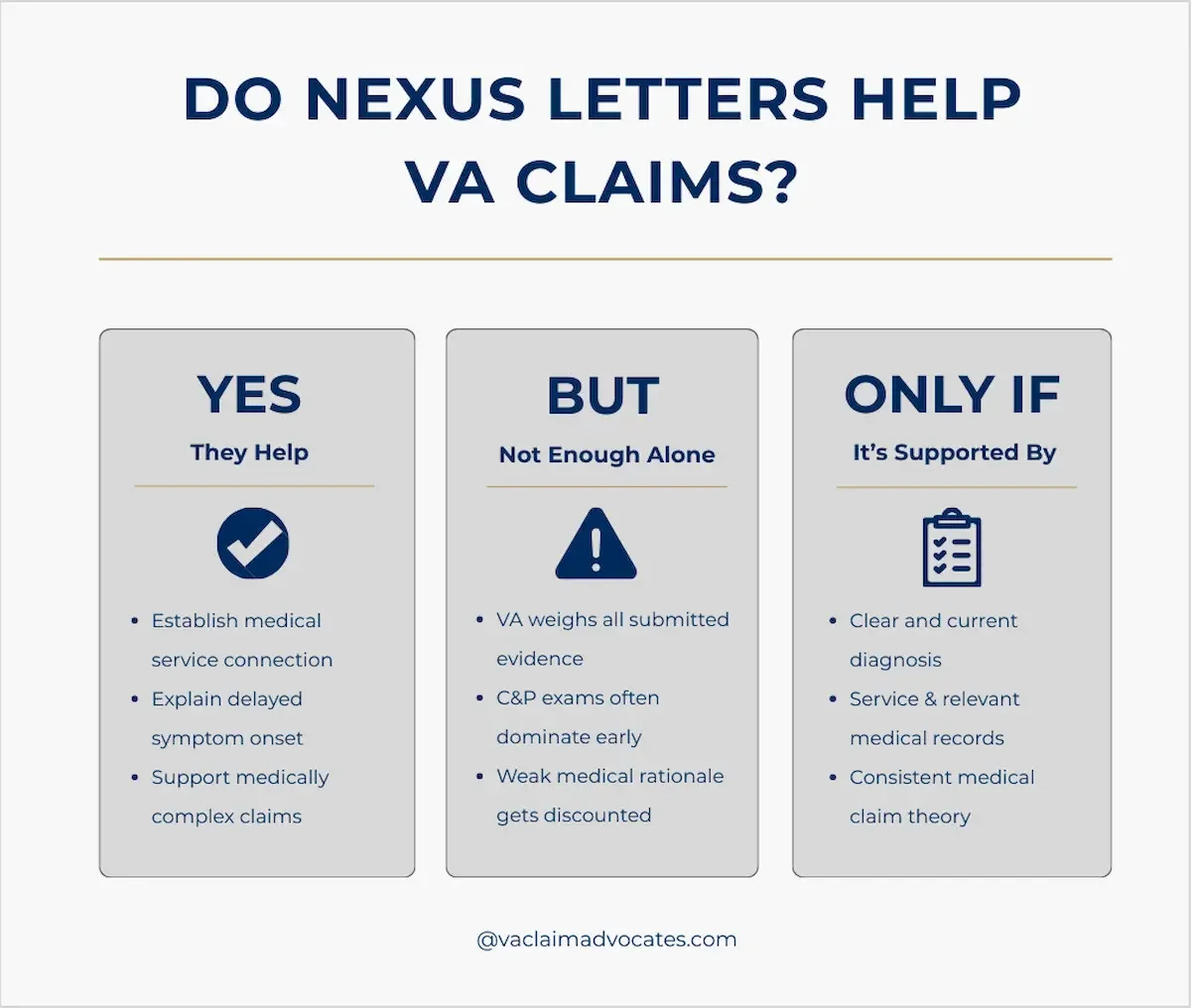
Yes, a strong medical nexus letter absolutely helps VA claims, but they are not a shortcut or a guarantee by themselves.
When written and supported correctly, they often become one of the most important pieces of evidence in winning an appeal.
VA Claims That Commonly Require Nexus Letters
Some claims almost always need a nexus letter to get approved, especially when service connection would otherwise be hard to prove.
A few common examples:
Symptoms that show up years later: Despite what many people assume, these claims are often approved when a nexus letter explains why delayed onset is actually more common than you might expect.
Sleep apnea claims: Sleep apnea can have many possible causes, and a nexus letter gives a doctor the opportunity to medically rule out alternatives and explain why service connection still makes sense.
Mental health conditions: PTSD, depression, and related conditions often require a medical professional to explain how the symptoms connect to service in a measurable way. This is also a key factor in how the VA evaluates mental health ratings.
Why a Nexus Letter Alone is Not Enough
Even a strong nexus letter does not guarantee approval because it can only connect existing evidence together to prove service connection.
It does not replace:
a clear, current medical diagnosis
supporting medical or service records
a claim theory that fits the facts of your case
Before submitting an appeal, it’s worth taking a moment to make sure the rest of your claim is just as solid.
You need foundational evidence like buddy statements, lay statements, and clear service records.
How to Fix or Strengthen a Weak Nexus Letter
If your nexus letter was discounted, it usually means the VA found gaps in how the medical reasoning was explained.
Strengthening a letter is often about clarifying the diagnosis, addressing all the available evidence, and writing more detailed rationale rather than starting over.
Common Nexus Letter Mistakes That Get Claims Denied
There are several issues that frequently weaken nexus letters and make them easy for the VA to discount. Some of the most common include:
Veterans try to self-diagnose: While veterans can report symptoms, a nexus letter requires a formal diagnosis from a medical professional.
Lack of understanding of the records reviewed: A doctor must reference all medical and service records and explain how they support the conclusion. This requires a full understanding of the veteran’s case and cannot be faked.
No clear medical rationale explaining the conclusion: The VA does not accept a conclusion simply because it comes from a qualified doctor. The doctor clearly explain the medical reasoning behind the opinion for it to carry weight.
The VA structures its system to naturally filter out weak or unsupported evidence. This is why a strong nexus letter often takes time to obtain.
Why Vague Medical Statements Hurt Your Claim
The VA does not require 100% certainty, but it does require objective medical opinions. Vague or ambiguous statements are not acceptable.
Examples include:
“PTSD causes sleep apnea.”
“Back pain is at least as likely as not due to military service.”
“The C&P examiner’s reasoning is incorrect.”
While these statements may sound convincing coming from a doctor, they do not explain the medical reasoning behind the opinion.
The VA expects at least a brief explanation describing the mechanism, progression, or evidence supporting the conclusion. I recommend that you review strong nexus letter examples so you understand exactly what this looks like
How to Properly Challenge a Negative C&P Exam
If a C&P examiner provided reasoning for why a condition is not related to service, a nexus letter should directly address that reasoning.
The key is to keep the critique grounded in clear, logical reasoning, not emotion. Avoid focusing on how unfair the exam felt or how poorly it was conducted.
Instead, calmly point out what the examiner overlooked or ignored and explain why their reasoning does not support the conclusion they reached.
Choosing the Right Appeal After a Nexus Denial
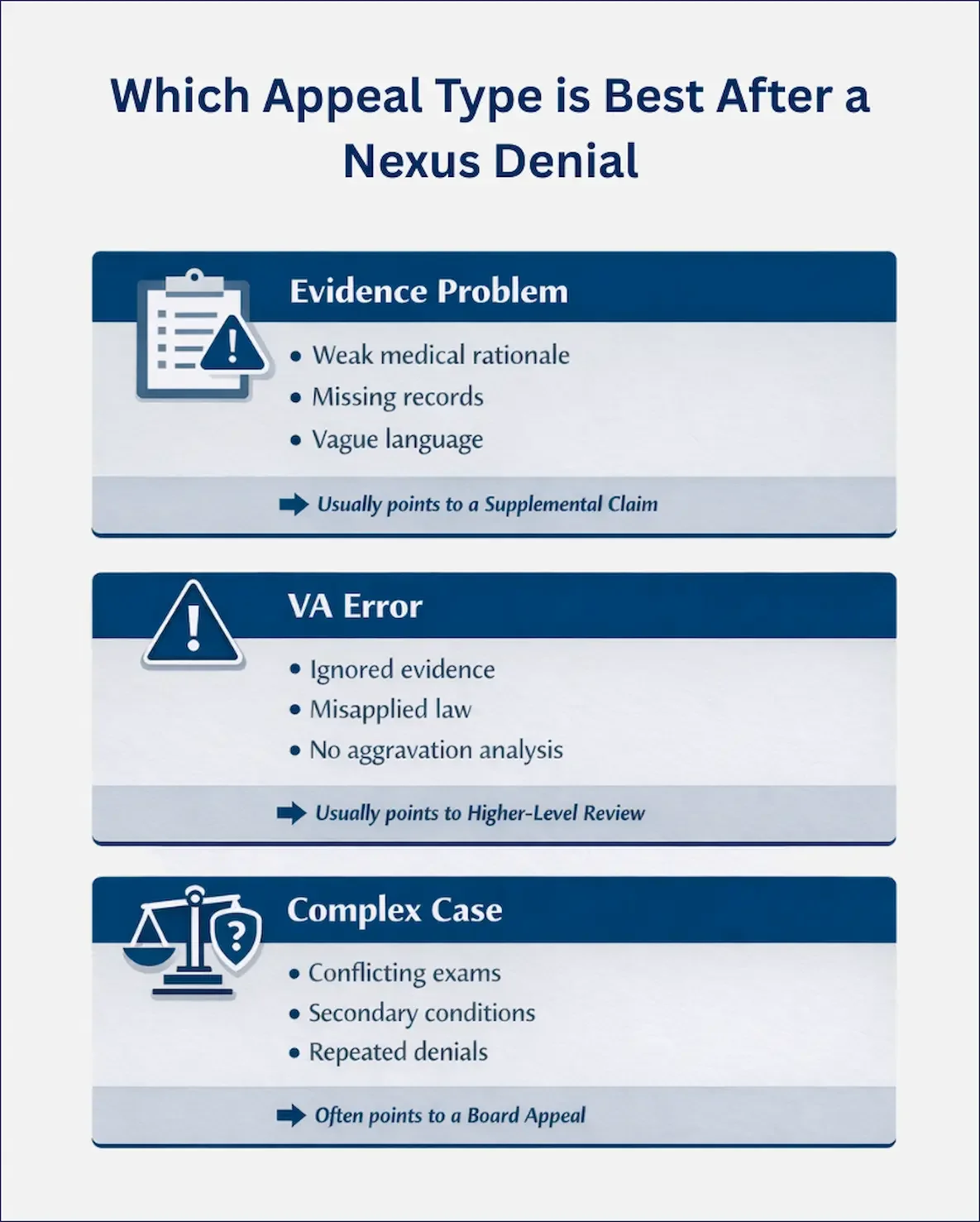
The best appeal option depends on why your claim was denied, not simply the fact that it was denied. To choose the right path, you must understand whether the issue was evidence, procedure, or legal error.
When to Submit a Supplemental Claim
You should consider a supplemental claim when the problem is the quality or completeness of the evidence, not a clear VA error.
This most often applies when:
Your nexus letter is weak: If your nexus letter does not meet the minimum requirements, submitting a stronger, updated one is usually the right move.
The VA discounted your letter with flawed reasoning: If an examiner gave reasons for discounting your nexus letter, a new opinion should directly address and rebut that reasoning.
Other parts of your claim are lacking: If other evidence in your claim is weak, a nexus letter alone will not carry as much weight.
A supplemental claim is not the right option if you have no new evidence to submit or if the denial is based on a clear factual mistake. Those situations are better handled through other appeal lanes, which I’ll cover next.
When a Higher Level Review Makes Sense
A Higher-Level Review is appropriate when the denial is based on a clear VA error, not a lack of evidence.
This most often applies when the VA failed to properly consider favorable evidence, misapplied the law, or made a factual mistake in the decision.
A Higher-Level Review does not allow new evidence, so it is only effective when the existing record already supports your claim and the problem lies in how the VA handled it.
If the VA addressed your nexus letter and relied on an examiner’s reasoning, or if you plan to submit additional evidence, a different appeal option is usually more appropriate.
When to Submit a Board Appeal
A Board appeal is typically appropriate when a claim is well supported but has been repeatedly denied due to unfavorable VA examinations or procedural errors.
The Board is required to review the full record, address favorable evidence, and explain how medical opinions are weighed under VA law.
These are usually necessary when:
The VA has discounted a strong nexus letter and claim without meaningful analysis.
The claim involves complex secondary or medical relationships that the VA has not fully acknowledged.
There are duty to assist errors that were not corrected by the VA.
The primary drawback of a Board appeal is time, as these cases often take significantly longer to resolve. They are typically reserved for situations where other appeal options have failed or are unlikely to succeed.
Why Certain Conditions Are Still Denied
Some conditions are denied more often because the medical connection to service is harder to explain, not because nexus letters do not work.
These denials usually depend on timelines, alternative causes, or how clear the medical link is.
Here is what you will often find for specific conditions:
Sleep apnea: Nexus letters for sleep apnea are often discounted when the medical rationale is weak, overly conclusory, or not supported by medical literature, especially in secondary claims.
PTSD: Nexus letters for PTSD frequently fail when they do not clearly establish the symptom timeline or fail to identify a specific in-service stressor tied to the diagnosis.
Tinnitus: Nexus letters for tinnitus are more commonly approved, but denials often occur when the letter suggests symptoms were intermittent, delayed without explanation, or inconsistent with service history.
Secondary conditions: Nexus letters for secondary conditions are frequently discounted when they confuse causation and aggravation or attempt to link conditions that are only loosely related without clear medical reasoning.
A Nexus Letter Denial Is Not the End of Your Claim
A VA claim denial, even with a nexus letter, does not mean your claim is over. Most denials come down to how evidence was weighed or explained, not the absence of service connection.
With the right corrections and appeal strategy, many claims succeed on review.
If you’re unsure why your claim was denied or what to do next, contact us to review your decision and help you choose the strongest path forward.
FAQ
-
When a nexus letter is well written and clearly explains the medical link, outcomes often improve as a claim moves through the VA process.
Based on observed claim outcomes, approximate success ranges typically look like this:
Initial claim (regional office level): ~40–60%
Supplemental claim (with revised or clarified evidence): ~50–65%
Board appeal (Board of Veterans’ Appeals): ~65–80%
These are not official VA statistics. They are rough estimates based on my own experience helping veterans with VA claims.
-
No. By law, the VA is required to consider and address all relevant evidence in a claim, including private nexus letters. They are not permitted to simply disregard medical evidence that is properly submitted.
That said, at lower levels of review—such as initial claims, supplemental claims, or Higher-Level Reviews—nexus letters are sometimes given little weight or addressed only briefly, especially if the VA relies more heavily on a C&P examiner’s opinion. In these situations, it can feel like the nexus letter was ignored, even though it was technically acknowledged.
At the Board of Veterans’ Appeals level, medical evidence is typically reviewed in a more objective and detailed manner. Conflicting medical opinions are analyzed more closely, and well-reasoned nexus letters tend to carry significantly more weight than they often do earlier in the process.
-
No. The VA does not objectively care whether a nexus letter was paid for or how much it cost. What matters is the content of the opinion.
That said, some paid services rely on pre-made or lightly customized templates, which the VA is often good at identifying. When a letter appears generic or doesn’t address the specifics of the claim, it is more likely to be given less weight.
In many cases, it’s reasonable to pay a doctor for their time, especially when they are reviewing records and providing a detailed medical opinion. Veterans should simply be cautious with paid companies, as quality varies widely and cost alone does not determine how persuasive a nexus letter will be.
-
Yes. The VA can order a C&P exam even if you submit a nexus letter, and in some cases it is required to do so. The exam is not meant to replace your nexus letter, but to evaluate it alongside the other evidence. The VA may request an exam to clarify medical questions, address issues like aggravation, or resolve conflicting medical opinions.
-
Yes. A specialist’s opinion often carries more credibility, but it does not automatically outweigh a VA examiner’s opinion. The VA focuses on the quality of the medical rationale, not the provider’s title. A well-reasoned, evidence-based opinion from a nurse practitioner can be given more weight than a vague or conclusory nexus letter from a specialist.
-
IThe VA must obtain a new medical opinion when a new nexus letter is submitted or when a prior VA exam is found to be inadequate, incomplete, or based on an inaccurate factual premise. In those situations, the VA cannot rely on the flawed exam and must correct the error by obtaining a properly structured medical opinion.