Nexus Letter for Sleep Apnea Secondary to Tinnitus: The Truth
Many veterans are told that sleep apnea secondary to tinnitus is impossible to win. And honestly, I get why people think that.
A lot of veterans who are already service connected for tinnitus end up developing sleep apnea years later, gather every piece of evidence they can, pay for an expensive nexus letter, and still get denied.
These claims are tough, no doubt. But the problem usually isn’t that the connection is “medically impossible.” It’s that the veteran presented the case in a way the VA doesn’t recognize or didn’t address the exact questions the VA needs answered.
The truth is, there is a medically credible pathway here. When you understand what the VA is actually looking for and get a strong nexus letter focusing on aggragation, these claims become winnable.
So instead of giving you vague advice, I’m going to break down exactly how this works.
I will cover when the connection makes medical sense, how the VA evaluates these claims, and what your nexus letter must include if you want a real shot at approval.
Can Tinnitus Really Lead to Sleep Apnea?
Contrary to popular belief, sleep apnea can be connected to tinnitus, but not in the way most veterans think.
This is a rare and difficult type of secondary claim, and if you want any chance of winning it, you must pay very close attention to how you present the medical link.
When the Connection Makes Medical Sense
Sleep apnea and tinnitus don’t have a direct cause-and-effect relationship. Tinnitus doesn’t create airway obstruction, and the VA is right about that part.
However, tinnitus is capable of worsening pre-existing sleep apnea. Many veterans simply think tinnitus “caused” their sleep apnea simply because they didn’t notice sleep issues until years after separating.
In reality, mild sleep apnea often goes undetected until something—like severe tinnitus—starts disrupting sleep cycles and makes apnea events more noticeable
These claims usually succeed only as aggravation claims. That means you’ll need a strong, detailed nexus letter explaining how tinnitus worsens your sleep apnea. Generic or vague letters are the main reason veterans get denied
Why the VA Usually Denies These Claims
While this connection can be proven, these claims are denied far more often than they’re granted. The link is rare, and the VA has a system built to filter out weak or poorly supported claims.
Veterans mainly get denied because:
The connection isn’t intuitive: To most VA examiners, tinnitus (a noise issue) and sleep apnea (an airway issue) look completely unrelated at first glance.
C&P examiners misunderstand the medical link: They correctly point out that tinnitus doesn’t cause sleep apnea, but they often ignore that tinnitus can aggravate it — and aggravation is legally enough for service connection.
Weak or generic nexus letters: Most denied claims have nexus letters that try to argue direct causation. That strategy usually fails. Aggravation is the real pathway, but the medical explanation explain the connection correctly.
If this feels complicated now, don’t worry. I’ll show you exactly how to work through these problems step-by-step later on.
How Tinnitus Can Aggravate Sleep Apnea
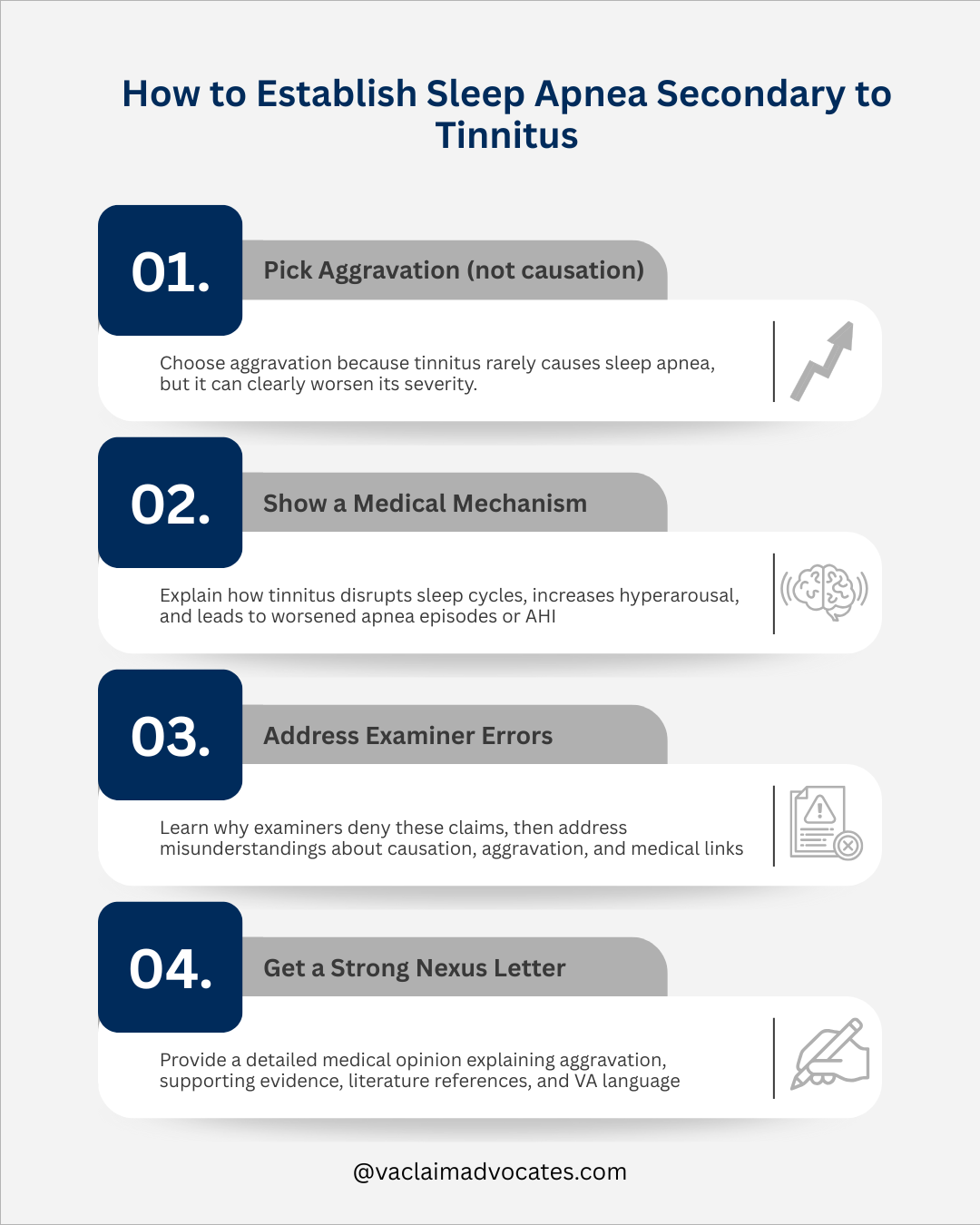
This is where most veterans get tripped up. Tinnitus doesn’t cause sleep apnea, and claiming that will lead to a denial. The real link is aggravation, meaning tinnitus can make sleep apnea worse. Here’s how.
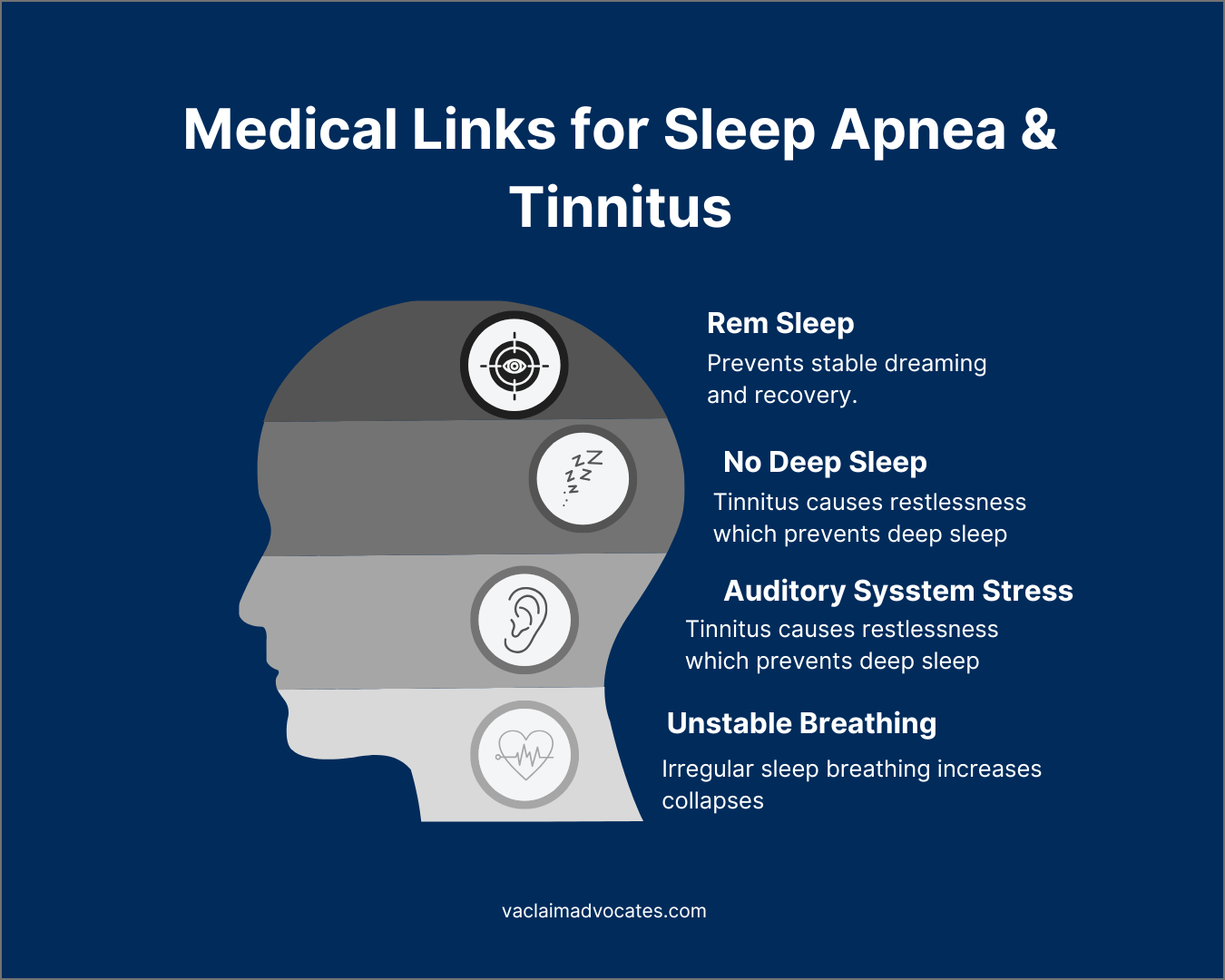
How Tinnitus Disrupts Rem Sleep
For some veterans, tinnitus becomes much louder at night. This repeatedly interrups rem sleep, which is responsible for regulating your mental health. Here’s how it works:
Tinnitus disrupts REM sleep: Ringing is louder at night, so it pulls you out of REM over and over.
Broken REM = unstable airway muscles: During REM, throat muscles normally relax in a steady rhythm. Constant interruptions throw that rhythm off.
Unstable muscles collapse easier: When those muscles relax at the wrong times, the airway can collapse.
Collapse causes obstructive sleep apnea events: When the airway collapses, airflow gets blocked, oxygen levels drop, and the body forces a gasping or choking awakening.
Summary: Tinnitus breaks REM → REM break = weak airway control → weak control = airway collapse → OSA events.
How Tinnitus Causes Unstable Breathing
Many veterans with tinnitus experience broken, restless sleep long before they’re ever diagnosed with sleep apnea. How the process works:
Tinnitus causes constant micro-awakenings: Even without fully waking up, your brain keeps getting interrupted.
This creates restlessness: Your brain stays on alert instead of resting normally.
Restlessness disrupts breathing control: Breathing becomes unstable—fast, slow, stopping, starting.
Instability worsens obstructive sleep apnea: Unsteady breathing makes airway collapse more likely.
Summary: Tinnitus → broken sleep → brain on high alert → unstable breathing → worse OSA.
How Tinnitus Blocks You From Reaching Deep Sleep
This is one of the most common and easiest-to-understand ways tinnitus can aggravate sleep apnea. Here’s what can happen:
Tinnitus makes it hard to fall asleep and stay asleep: The ringing is loudest at night, so your brain keeps waking up or lightly waking without realizing it.
These constant interruptions prevent you from reaching deep, restorative sleep: Deep sleep and REM are where your breathing becomes the most stable.
When you don’t reach deep sleep, your breathing stays irregular: Your throat muscles don’t get the steady rhythm they need.
Irregular breathing makes OSA events more likely: Unstable breathing causes airway to collapse more often which worse sleep apnea.
Summary: Tinnitus breaks your sleep cycles → broken sleep throws off breathing → unstable breathing = more airway collapses → worsened sleep apnea.
What a Nexus Letter for Sleep Apnea Secondary to Tinnitus Must Include
Medical opinions only help if they’re written the right way. The VA has high standards for sleep apnea nexus letters, especially when tinnitus is involved.
Your nexus letter has to clearly explain your symptoms, sleep history, and evidence. Anything vague or generic won’t meet the standard
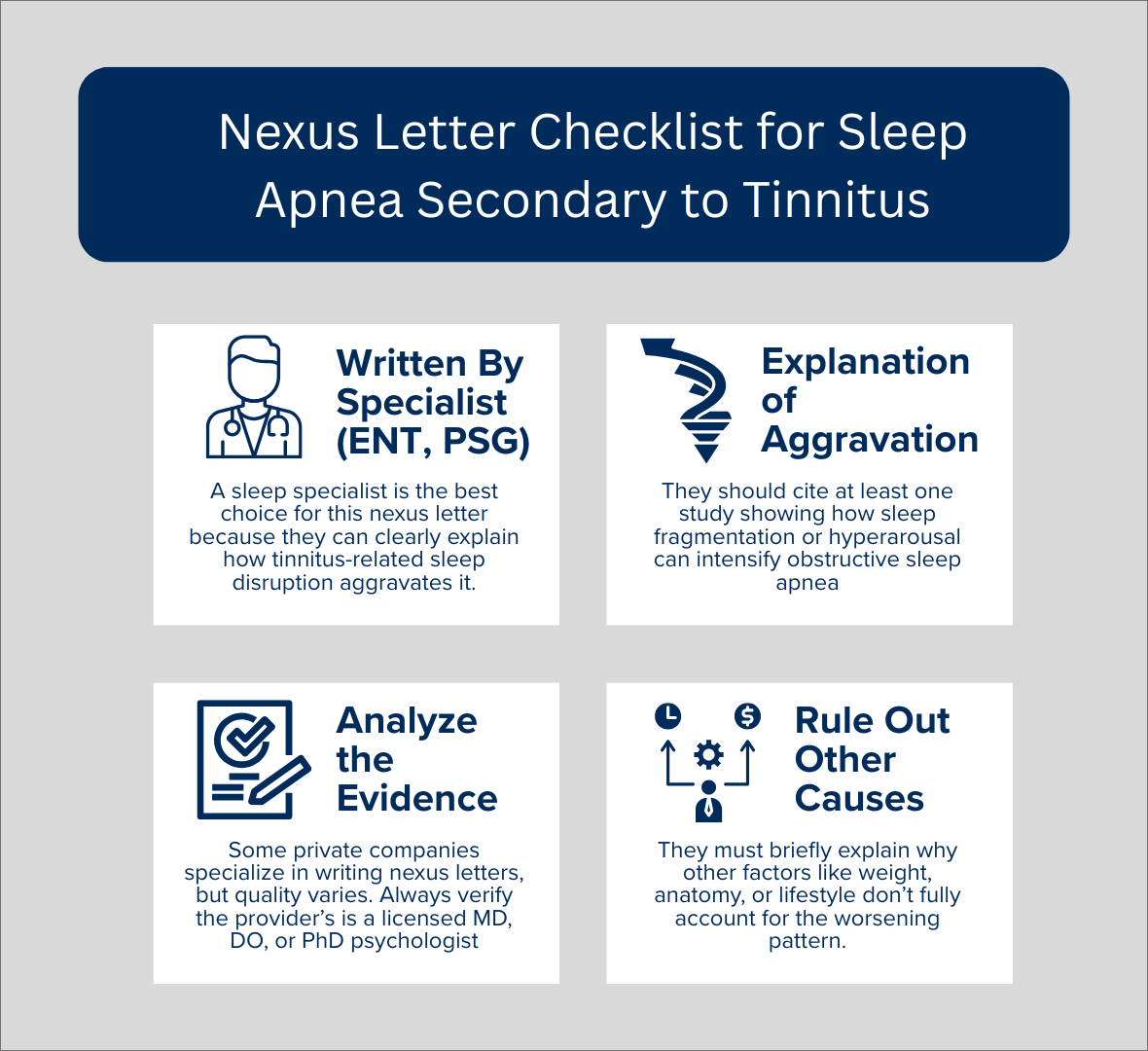
Written by a Qualified Sleep or Tinnitus Specialist
The VA takes nexus letters way more seriously when they’re written by a doctor who understands both tinnitus and sleep apnea.
This usually means:
an ENT
a sleep medicine specialist
an audiologist with experience in sleep-related cases
a physician who routinely writes VA medical opinions
Finding the right doctor to write your nexus letter may take time but is essential. True specialists are the only doctors who can explain the link between sleep apnea and tinnitus in a way VA examiners understand.
Clearly Explains How Tinnitus Worsened Sleep Apnea
The nexus letter must clearly state whether tinnitus caused sleep apnea or aggravated it. In most cases, veterans win these claims through aggravation.
Make sure you doctor is aware that the VA will not accept statements like “my tinnitus made my sleep apnea worse.” They want to see measurable changes.
This can include the following:
comparing older sleep studies to newer ones
showing higher AHI scores, more breathing interruptions
More REM awakenings after the veteran’s tinnitus became more severe.
A new sleep is the best way to show clear, measurable evidence to show your sleep apnea worsened after tinnitus began. It makes your nexus letter much stronger.
Uses Evidence that Matches Your Records
The VA wants to see that the doctor actually looked at the veteran’s records—not just copied a template.
A strong nexus letter should mention:
the veteran’s sleep study results
tinnitus severity and history
documented sleep complaints
medical literature linking tinnitus + sleep disturbance + OSA
But the key isn’t quoting studies. The key is explaining what those studies mean for THIS specific veteran, not in general.
Rules Out Other Likely Causes (Like Obesity)
VA examiners deny most claims by blaming other possible causes. This is absolutely critical for proving secondary service conditions because they are more likely to have alternative causes.
Here are a few that are most common for sleep apnea and tinnitus:
obesity
age
enlarged tonsils
anatomy
smoking
family history
VA examiners love to blame obesity. It’s the #1 reason sleep apnea claims get denied, even when there’s a real secondary connection.
C&P Exam When Tinnitus Worsens Sleep Apnea
C&P exams are unpredictable, and avoiding rejection is extremely difficult no matter how well-prepared you are.
Even with strong symptoms and evidence, examiners often rely on rigid templates that lead to denials. Because of that, you should expect the examiner to raise objections—and be ready to overcome them with a strong nexus letter.
Common C&P Examiners Arguments
Here are five realistic, C&P-style examiner statements written exactly the way they appear in denial opinions:
“Tinnitus does not affect the upper airway and therefore cannot cause or aggravate obstructive sleep apnea.”
“The Veteran’s sleep apnea is more likely explained by established risk factors such as weight, age, and smoking history, rather than tinnitus.”
“There is no medical literature supporting a causal relationship between tinnitus and the development of obstructive sleep apnea.”
“Sleep disturbance from tinnitus does not create the anatomical airway obstruction required to diagnose obstructive sleep apnea.”
“It is less likely than not that tinnitus or its treatment contributed meaningfully to the Veteran’s sleep apnea beyond its natural progression.”
Sometimes, examiners will find a reason to give you a negative opinion no matter what you say. The key is properly addressing them in your nexus letter.
Using a Nexus Letter to Overcome Their Objections
A strong nexus letter can fix what the C&P exam usually misses. Here’s how it helps:
Highlights Missing Aggravation Analysis
It points out when the examiner failed to discuss how tinnitus worsened sleep apnea over time and reframes the claim around aggravation rather than causation.Shows Combined Contributing Factors Clearly: It explains how tinnitus played a role in addition to weight, age, or other causes, giving a full and accurate picture of what led to the Veteran’s sleep apnea.
Cites Relevant Sleep-Science Research: It uses accepted medical literature on sleep fragmentation, hyperarousal, and airway instability to challenge the idea that “no medical link exists.”
Connects Evidence to Veteran Specifically: It applies the medical reasoning directly to the Veteran’s symptoms, timeline, sleep history, and functional impact, making the opinion stronger and individualized.
Even a single unchecked C&P objection can undermine an otherwise strong claim. If the examiner raises an issue you don’t address, the VA may deny your claim even with a nexus letter.

Nexus Letter for Sleep Apnea Secondary to Tinnitus Example
Below is a good example of a nexus letter for sleep apnea secondary to tinnitus. It’s more thorough than what some claims require, but this is what detailed nexus letters looks like.
John Doe
SSN: XXX-XX-1234
DOB: March 4, 1985
VA File Number: 12345678
To Whom It May Concern,
My name is Dr. Michael R. Hale, MD, and I am a board-certified sleep medicine physician. I have reviewed Mr. John Doe’s VA records, sleep studies, service history, and lay statements.
Annotation: Establishes that the provider is a qualified sleep specialist, which increases the weight of the opinion.
Mr. Doe served in the U.S. Navy from 2006–2011 as an engine room technician, working around constant high-decibel machinery. He developed chronic, bilateral tinnitus during service, which has worsened over time and is most severe at night.
He was diagnosed with moderate obstructive sleep apnea in 2018, confirmed by a sleep study showing an AHI of 21. Since that diagnosis, he has continued to struggle with sleep maintenance, frequent awakenings, and significant daytime fatigue.
Annotation: Confirms the current sleep apnea diagnosis and baseline AHI, which are required for any secondary service connection. Also creates a starting point to measure worsening.
Multiple VA examiners denied his claim by saying tinnitus “does not cause sleep apnea” and by pointing to common risk factors such as age, BMI, and past smoking.
While tinnitus does not cause airway obstruction, these opinions did not evaluate whether tinnitus aggravated his sleep apnea, which is the required standard under 38 CFR 3.310(b).
Annotation: Shows that VA examiners focused only on causation and not on aggravation. Identifies the central error the nexus letter must correct
The correct medical question is whether tinnitus made his sleep apnea worse than its normal progression. Based on his reports and partner observations, Mr. Doe now wakes 10–12 times nightly, compared to 3–4 times before his tinnitus became more severe. His sleep logs show the same pattern of repeated nighttime arousals.
Medical research supports this type of worsening. Studies in Sleep Medicine Reviews and Journal of Clinical Sleep Medicine show tinnitus causes hyperarousal and frequent awakenings. Research published in Chest and Sleep demonstrates that fragmented sleep reduces airway stability and can increase obstructive breathing events.
Annotation: Documents measurable worsening (increased awakenings) to prove aggravation. Quantifying before-and-after symptoms is one of the strongest forms of evidence
A 2021 study in Sleep & Breathing also found that patients who experience frequent nighttime awakenings often have higher residual apnea severity, even when using CPAP. These findings match Mr. Doe’s symptoms and sleep patterns.
The medically supported chain is clear:
Tinnitus → sleep disruption → more awakenings → reduced airway stability → worsened apnea.
Risk factors such as age, BMI, and past smoking explain his baseline apnea, but they do not explain the increase in awakenings, fatigue, and daytime dysfunction. His weight has remained stable, and there is no alternative explanation for the degree of worsening documented in his records.
Annotation: Acknowledges age, BMI, and smoking but shows they don’t explain the degree of worsening. Reinforces that stable weight undermines the risk-factor argument
The prior VA opinions were incomplete because they focused only on causation (“tinnitus doesn’t obstruct the airway”) and did not address whether tinnitus made the apnea worse, which is the legally required aggravation analysis.
Based on the medical evidence, his sleep patterns, and the timeline of symptom progression, it is my professional opinion that Mr. Doe’s service-connected tinnitus has aggravated his obstructive sleep apnea beyond normal progression.
Therefore, it is at least as likely as not (50% or greater probability) that tinnitus aggravated his obstructive sleep apnea.
Sincerely,
Michael R. Hale, MD
Board-Certified in Pulmonary & Sleep Medicine
License #A1234567
Final Thoughts On Nexus Letters Linking Sleep Apnea & Tinnitus
Sleep apnea secondary to tinnitus is one of the hardest VA claims to get approved, but it is absolutely winnable when you take the time to build it the right way.
The veterans who succeed aren’t the ones who rush through the process — they’re the ones who understand the medical link, gather the right evidence, and get a nexus letter that actually answers the VA’s questions.
If you approach this step-by-step, rule out the common denial traps, and present a clear aggravation argument, you give yourself a real shot at winning a claim most people mistakenly think is “impossible.”
If you want help reviewing your claim strategy or making sure you’re on the right track, you can reach out to us anytime.
FAQ
-
Yes — a single nexus letter can link sleep apnea to both tinnitus and a mood disorder, but the letter will naturally be longer because each connection must be explained clearly.
If both conditions aggravate sleep apnea through similar mechanisms like hyperarousal or sleep fragmentation, it’s usually easier to justify within one opinion. If they involve different medical pathways, the doctor must provide separate, detailed rationales for each link so the VA doesn’t view the letter as vague or unsupported.
As long as each mechanism is explained independently and the provider is qualified, one nexus letter is acceptable
-
Some nexus letters linking sleep apnea to tinnitus win because they clearly explain how tinnitus aggravates sleep apnea, rather than incorrectly claiming it causes it.
Successful letters describe timing, severity, sleep disruption, and rule out alternative explanations so the VA has a detailed medical pathway to rely on. The ones that fail usually make vague statements, ignore C&P examiner objections, or simply say the two conditions are related without any explanation.
The difference almost always comes down to whether the doctor provides a precise, well-supported aggravation rationale instead of a brief or incorrect causation claim
-
The most common nexus for sleep apnea secondary to tinnitus is simply that tinnitus keeps you from getting steady, uninterrupted sleep, which makes your sleep apnea act up more.
The constant ringing can make it harder to fall asleep, wake you up throughout the night, and keep your body in a lighter, restless sleep state. When someone already has sleep apnea—especially if it’s moderate or severe—this broken sleep makes the apnea episodes worse and more frequent. So the connection isn’t that tinnitus causes sleep apnea, but that it aggravates it by disrupting sleep
-
No, tinnitus doesn’t always worsen sleep apnea. It mainly depends on how severe each condition is to begin with — mild tinnitus may not disrupt sleep much, and mild sleep apnea may not react strongly to occasional sleep disturbances. But when tinnitus is loud or constant, and the sleep apnea is already moderate or severe, the broken sleep from tinnitus can make apnea episodes noticeably worse. The VA looks for this kind of clear aggravation pattern, not just the fact that both conditions exist