VA Tinnitus Rating Explained: How to Qualify & Avoid Denials
Tinnitus should be one of the easiest VA disability conditions to get rated, yet thousands of veterans are denied every year, even with legitimate claims.
C&P exams are often inconsistent, claims without hearing loss are misunderstood, and many veterans are wrongly told they waited too long after service to qualify.
The truth is that most tinnitus denials have little to do with whether the condition was actually caused by military service.
In this guide, you’ll learn exactly how VA tinnitus ratings work, how to build the strongest possible claim, how to avoid common C&P exam mistakes, and what upcoming rule changes could mean for your benefits.
Key Points for VA Tinnitus Ratings
- Tinnitus is currently rated at a maximum of 10%. It is one of the easiest conditions to service connect when noise exposure is proven.
- A strong personal statement is the most important evidence. It should explain when ringing started, what noise exposure caused it, and that symptoms have continued since service.
- Hearing loss is NOT required for a tinnitus rating. Many veterans are granted tinnitus even with normal hearing test results.
- C&P examiners often deny claims using faulty logic. Common excuses include no treatment in service or no hearing loss — neither automatically disqualifies tinnitus.
- Thoroughly explain your symptoms during C&P Exam. Clearly describe when the ringing began, what caused it, and how it has remained consistent over time
What You Need to Qualify for a Tinnitus Rating
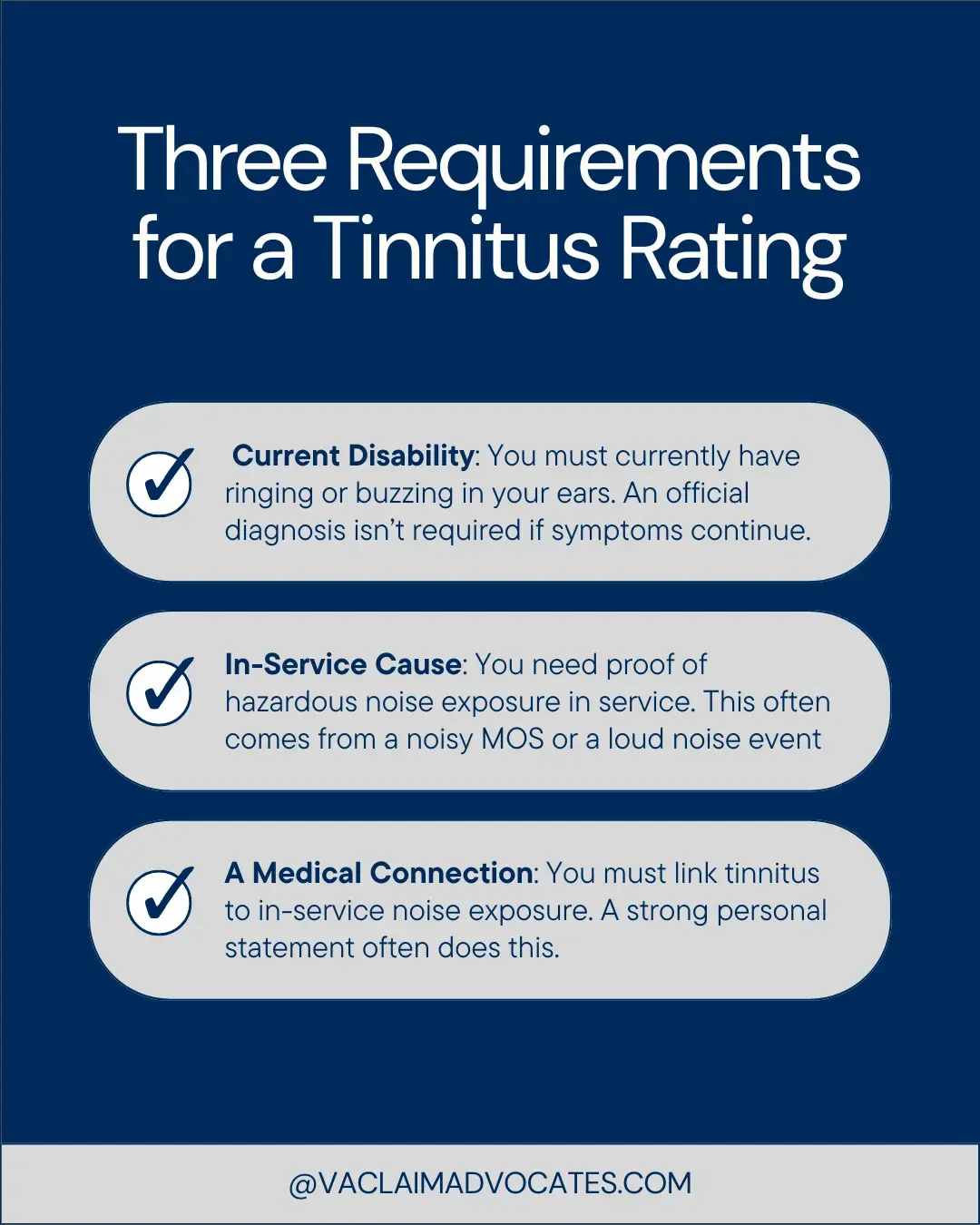
There are three criteria the VA uses for tinnitus ratings: Evidence of a current disability, an in service cause, and a medical connection showing how tinnitus is connected to that cause.
Proof of Noise Exposure During Service
The first step in getting a tinnitus rating is showing that you were exposed to hazardous noise during your military service.
Most veterans qualify in one of two ways:
A job with regular noise exposure – The VA uses an MOS noise exposure list that ranks military jobs by how likely they are to involve hazardous noise. This includes roles working around weapons, aircraft, heavy equipment, engines, and machinery.
A specific loud noise event – If your job isn’t on the MOS exposure list, you can still qualify by pointing to a separate loud noise event. This could include things like explosions, live-fire training, or incidents on the flight line.
If your job appears on the MOS list, the VA usually assumes the noise exposure happened.
If it doesn’t, you’ll need to clearly explain when, where, and how the exposure occurred so the VA can recognize it as your stressor.
Proof Your Tinnitus Is Linked to That Exposure
To prove tinnitus is a current disability, you need to show how your hazardous noise exposure is related to your condition today.
You don’t need an official tinnitus diagnosis, but you do need to show:
Tinnitus symptoms began in service: You need to show the exact time when your symptoms began.
Symptoms still exist: You need to show that your tinnitus symptoms still affect you today.
Symptoms are recurrent, not on and off: You need to show that your symptoms have remained constant, even if you have good and bad days.
The Evidence That Helps Win a Tinnitus Claim
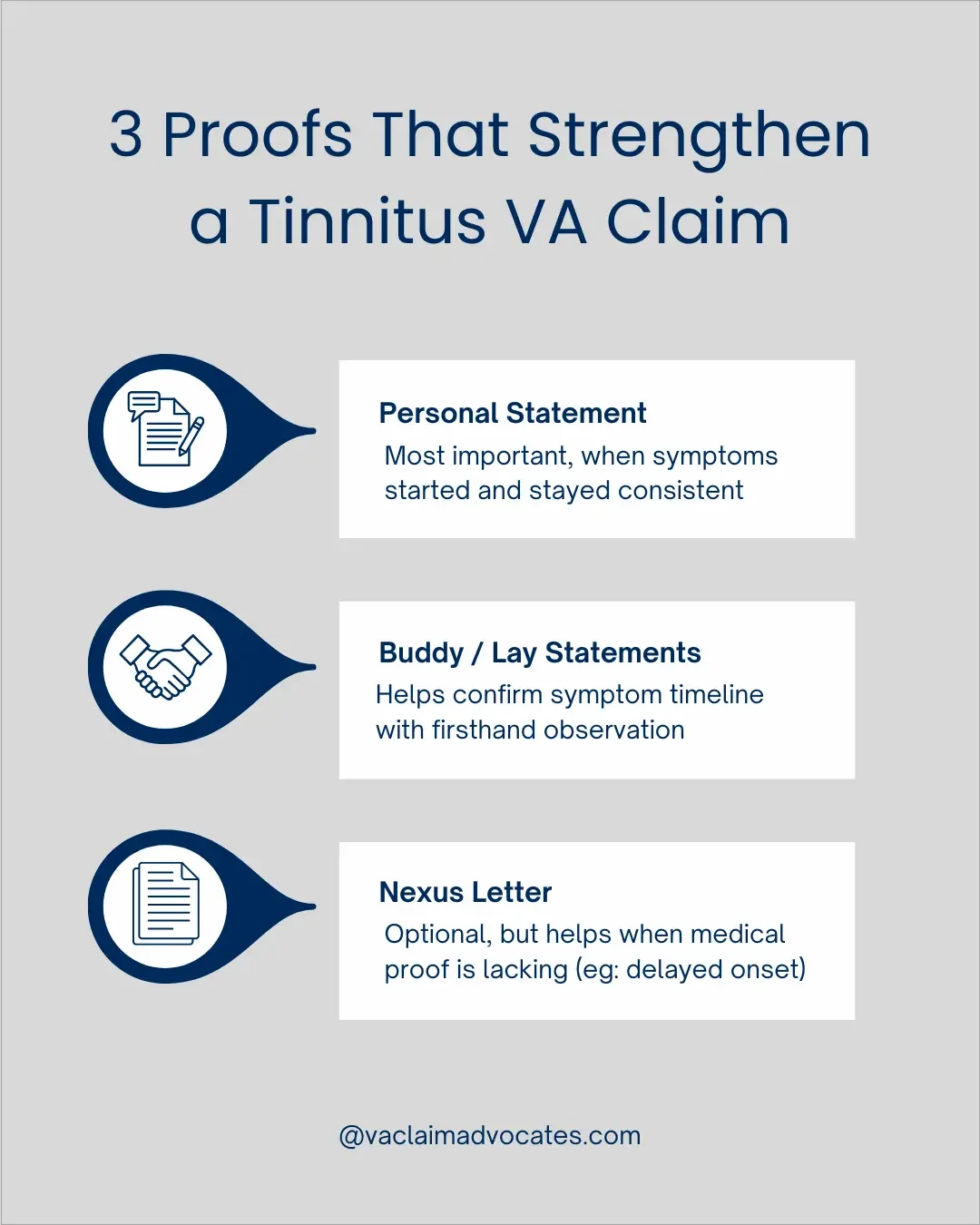
The most important piece of evidence for a tinnitus rating is a detailed personal statement explaining what caused your tinnitus and when your symptoms began.
Other helpful evidence can include buddy or lay statements that support your timeline of symptoms, and in some cases a nexus letter to address gaps in the claim.
Personal Statement (Most Important Evidence)
Because tinnitus is a subjective condition, the VA relies heavily on your personal experience and testimony, rather than medical tests.
This does not mean the VA automatically takes your word for it. They need to see that you have a clear and consistent story over time.
A strong personal statement should clearly explain:
When your tinnitus began – during service, after a specific event, or shortly after discharge
What caused it – noise exposure, training, explosions, machinery, aircraft, etc.
How often you experience symptoms – constant, daily, intermittent, flare-ups
Whatever you put in your personal statement should be the same story you stick with throughout your claim process.
Buddy & Lay Statements (Supporting Your Timeline)
Buddy and lay statements help support your tinnitus claim by confirming when your symptoms started and how they’ve continued over time.
Here’s the role each play:
Buddy statements – written by fellow service members who can confirm noise exposure or when your symptoms began during service.
Lay statements – written by family members, spouses, friends, or coworkers who can confirm you’ve had ringing in your ears since service.
While not as critical as your personal statement, these are excellent supporting pieces of evidence that help establish a consistent timeline of symptoms.
Nexus Letter (Only Needed in Some Cases)
A nexus letter is a written medical opinion from a doctor that connects your tinnitus to your military service when the connection isn’t obvious based on records alone.
Many claims don’t need a nexus letter for tinnitus. However, veterans may need one in situations such as:
You have tinnitus without hearing loss: Tinnitus does not always cause hearing loss, even though some examiners mistakenly assume it does.
Your symptoms began years after service: Delayed onset tinnitus can happen, but the VA often questions it without medical explanation.
Your job had low noise exposure on paper: Low exposure roles can still cause tinnitus, but the VA may require stronger evidence.
In these cases, a nexus letter can help explain the medical reasoning and strengthen the connection to service.
Why Many Tinnitus Claims Get Denied at C&P Exams
Because tinnitus is primarily evaluated based on reported symptoms, some C&P opinions rely on a lack of hearing loss or in-service treatment when issuing a negative opinion.
This is a common source of negative exams, even though tinnitus can exist independently of hearing loss and often isn’t reported during service.
“Normal Hearing at Discharge”
Examiners may argue that because your hearing tests were normal at discharge, your tinnitus could not be related to service.
Why they think this:
They assume tinnitus always comes with measurable hearing loss
Why this isn’t always valid:
Tinnitus can exist even with normal hearing
Many veterans develop ringing before hearing loss becomes noticeable
Normal hearing at separation is common in tinnitus claims. Because tinnitus evaluations hinge on reported symptoms, your evidence should strongly support the timeline, frequency, and severity of the ringing.
“No Complaints in Service Records”
Some examiners point out that tinnitus wasn’t documented in your service medical records, assuming that no treatment means no symptoms.
This isn’t always accurate because:
Many veterans think ringing is normal after noise exposure.
Some veterans aren’t aware that tinnitus is a disability
While the VA may consider a lack of in-service treatment as evidence, it can’t be the only reason a claim is denied.
“Symptoms Aren’t Ongoing”
Examiners sometimes conclude tinnitus isn’t service connected because symptoms seem brief or intermittent.
In reality, tinnitus is chronic for most veterans, meaning the ringing is always present even if some days are better than others.
Describing it as something that “comes and goes” can unintentionally suggest it isn’t ongoing, so it’s important to emphasize that the symptoms have been consistent over time, even with fluctuations in intensity.
Upcoming VA Changes to Tinnitus Ratings
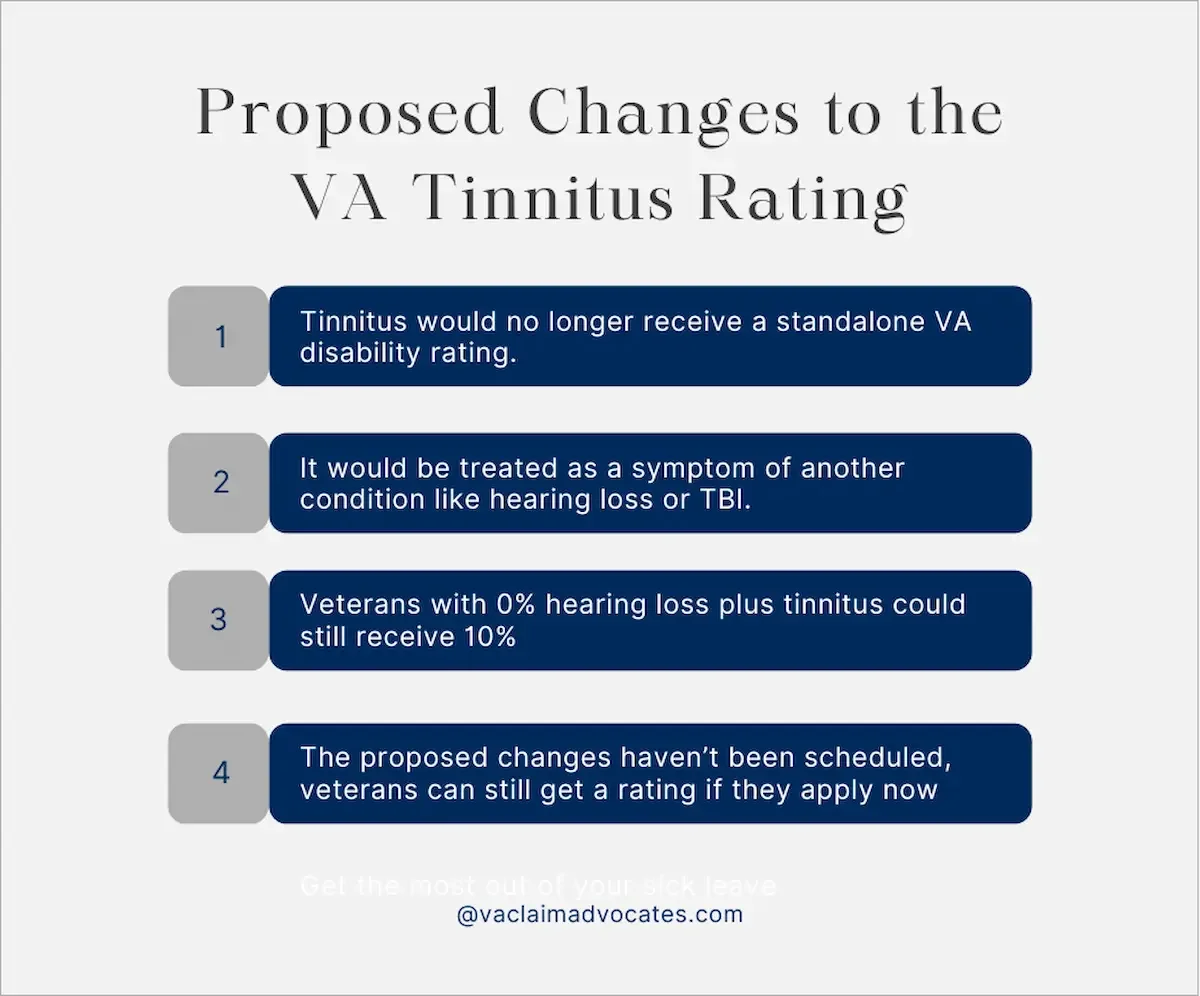
Under the proposed VA rule changes, tinnitus would no longer receive its own disability rating.
Instead, it would be treated as a symptom of an underlying condition such as hearing loss, sleep apnea, traumatic brain injury (TBI), and PTSD.
Tinnitus May No Longer Be a Standalone Rating
Right now, veterans can receive a flat 10% disability rating for tinnitus alone, even without hearing loss or another related condition.
If the new rule takes effect:
The VA would eliminate the current tinnitus rating code
Tinnitus would be considered a symptom, not a separate disability
Compensation would only be possible if tinnitus is linked to an underlying service-connected condition
This doesn’t mean service connection for tinnitus doesn’t help at all. It can still help you obtain a disability rating for migraines or other conditions that are often worsened by tinnitus.
When Veterans Could Still Receive 10%
The proposed rule includes one narrow situation where tinnitus could still result in compensation.
Veterans may receive 10% for tinnitus only if:
They have service-connected hearing loss
The hearing loss is rated at 0% (noncompensable)
The tinnitus is medically linked to that hearing loss
If hearing loss is already rated at 10% or higher, tinnitus would not add any extra percentage.
This means most veterans who currently rely on tinnitus as an easy standalone 10% rating would likely no longer qualify under the new system.
When These Changes Might Start
As of now, these tinnitus changes are part of a proposed rule, not a finalized VA regulation. This is not a part of the rule changes that have already taken place, such as changes to VA digestive ratings.
That means:
The current tinnitus rating system is still in place
Veterans can still file tinnitus claims as a standalone condition today
No official effective date has been announced
If finalized, the changes would only apply to new claims filed after the effective date. Veterans who already have tinnitus service connection would keep their existing ratings.
Claiming Tinnitus as a Secondary Condition
While most veterans can get a tinnitus rating through direct service connection, there are some circumstance when filing as a secondary condition may be the best option.
Conditions Commonly Linked to Tinnitus
Instead of filing tinnitus on its own, veterans would need to show that their tinnitus developed as a result of another condition, such as:
Hearing loss from noise exposure
Traumatic brain injury (TBI)
Inner ear disorders like Meniere’s disease
Certain neurological or vascular conditions
Secondary conditions often require a nexus letter, since the medical connection is more complex.
How to Strengthen a Secondary Tinnitus Claim
To successfully claim tinnitus as a secondary condition, veterans typically need:
A current tinnitus diagnosis or documented symptoms
A service-connected primary condition (such as hearing loss or TBI)
Medical evidence linking tinnitus to that condition
For example, a veteran with service-connected hearing loss may receive compensation for tinnitus if a medical provider confirms the tinnitus is caused by the hearing damage.
Why Secondary Claims May Matter More Going Forward
If the new tinnitus rules are finalized:
Standalone tinnitus claims would largely disappear
Secondary tinnitus claims would become the main path to compensation
Even though tinnitus is considered a symptom, it is often linked to an underlying condition that began during military service, most commonly hearing loss or noise-related damage.
Many veterans can establish service connection by identifying and proving that primary condition.
Final Thoughts on Tinnitus VA Ratings
Tinnitus remains one of the most common VA disability claims, and for now, veterans can still receive a standalone 10% rating by showing service-related noise exposure and consistent symptoms.
However, the VA has proposed major rule changes that would eliminate tinnitus as its own rating and require it to be linked to an underlying condition instead.
Because these changes could make future claims more difficult, veterans who currently experience tinnitus may benefit from filing sooner rather than later.
If you need help understanding your options or strengthening your claim, contact us today to speak with a team that specializes in VA disability claims.
FAQ
-
No. The hearing test measures hearing loss, not tinnitus. Tinnitus is usually evaluated based on your symptoms and service history.
-
To check for hearing loss and rule out other ear conditions. The test supports the exam but doesn’t decide tinnitus by itself.
Examiners are also often required to test for hearing loss if they are testing for tinnitus
-
Yes. Many veterans are granted tinnitus even without in-service records, as long as they provide a credible timeline and noise exposure history
-
Yes. Hearing loss and tinnitus are separate conditions. Normal hearing does not disqualify a tinnitus claim.
-
You should avoid saying anything that indicates that your tinnitus is off and on and instead explain how some days are worse than others but ringing is always present.
-
Not currently. There have been discussions over the years, but tinnitus is still rated under the existing system. Rumors about flat payments are common but not implemented
-
Yes, it’s possible, but it usually requires strong medical evidence.
Sleep apnea can sometimes be linked to tinnitus through underlying conditions such as hearing damage, neurological issues, or related health factors.
But for most of these claims need a well-supported nexus letter explaining the connection.