
VA Sleep Apnea Ratings Explained: Percentages & CPAP Rules
Sleep apnea is one of the most common VA disability claims, yet many veterans struggle to receive the proper rating.
Some veterans are even service connected and even prescribed a CPAP, yet still have difficulty getting the sleep apnea rating they deserve.
The truth is that sleep apnea ratings are much easier to obtain once you understand what the VA is looking for.
This guide covers everything you need to know about VA sleep apnea ratings, including how they work, what each percentage means in real life, how CPAP use affects your rating, and what common VA errors can lower compensation.
You’ll also learn about potential rating changes and why they may actually be more positive than many veterans think.
Quick Summary of Sleep Apnea VA Ratings
- Sleep apnea is currently rated at 0%, 30%, 50%, and 100%. Your percentage is mainly based on daytime tiredness and whether you medically require a CPAP machine.
- New rules may remove the 30% rating and automatic 50% CPAP ratings. Future ratings would focus more on overall impairment.
- Service connection is the hardest step. Veterans must prove sleep apnea is linked to military service, often as a secondary condition.
- VA errors commonly lower ratings. This usually happens when CPAP use isn’t documented correctly or records aren’t fully reviewed, but these mistakes can often be fixed.
- Under the current system, you automatically qualify for 50% if you are service connected, prescribed a CPAP, and have consistent documented use.
How VA Disability Ratings for Sleep Apnea Work
Sleep apnea has long been recognized by the VA as a compensable disability, with ratings based on symptoms and required treatment rather than diagnosis alone.
Does the VA Recognize Sleep Apnea as a Disability?
Yes, obstructive sleep apnea is extremely common among veterans, and thousands receive VA disability compensation for it each year.
In most cases, veterans develop sleep apnea as a result of another service-connected condition rather than directly from service.
It is commonly linked as a secondary condition to:
PTSD and mental health conditions (often through weight gain, sleep disruption, or medication side effects)
Respiratory conditions like asthma or chronic sinus issues
Other service-related health changes that affect breathing and sleep
These are not the only conditions you can connect to sleep apnea, just the most common ones.
Steps to Qualify for a Sleep Apnea VA Rating
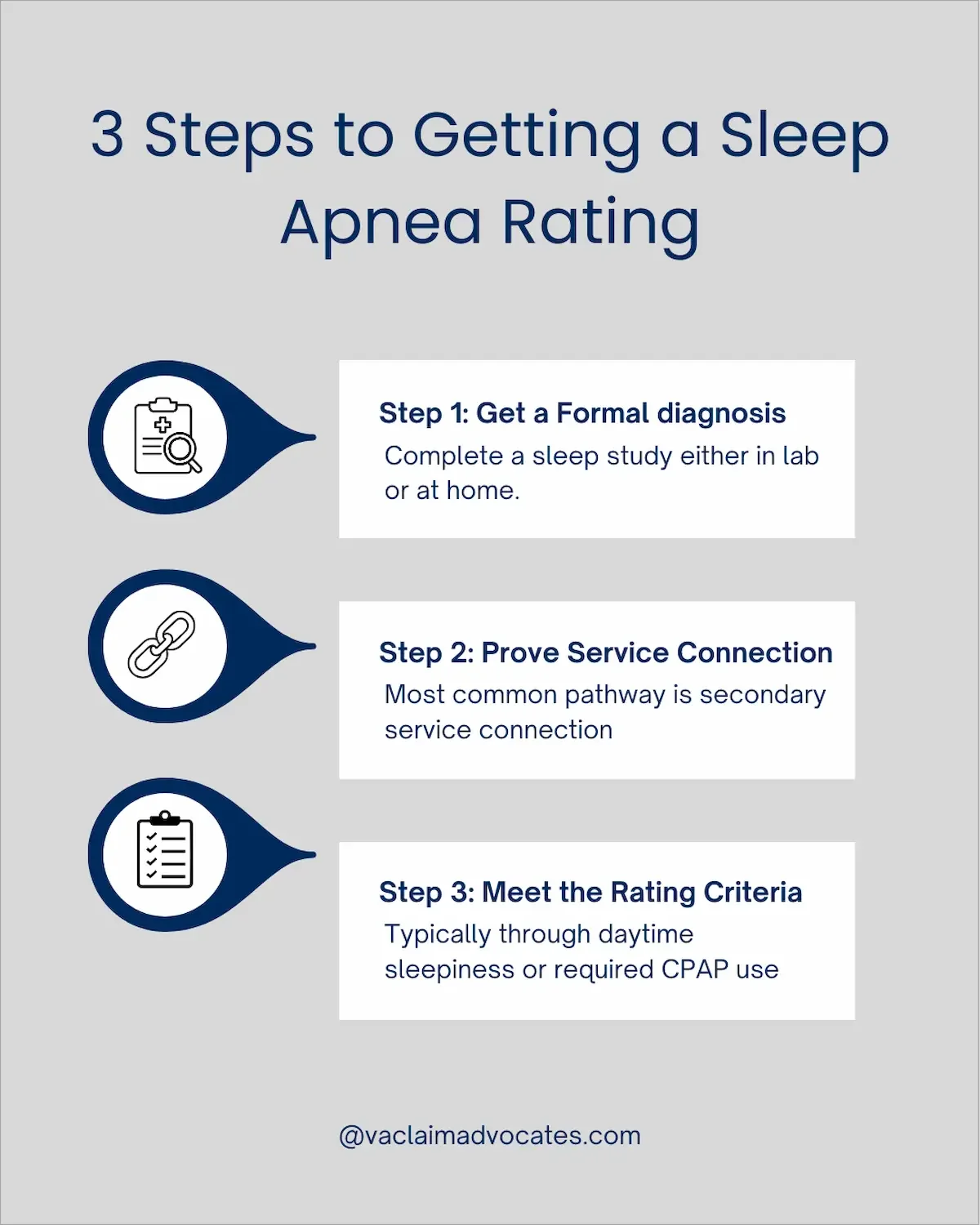
To get a rating for sleep apnea, you need three things:
Formal Sleep Apnea Diagnosis: You must first have an official diagnosis from an in-lab sleep study or at-home test.
Medical Connection to Service: Sleep apnea is usually connected to service as a secondary condition. The medical link often needs to be clearly explained by a nexus letter for sleep apnea and carefully developed.
Meet Impairment Criteria: Once you’ve established service connection, which focus on symptoms and required treatment like daytime sleepiness or CPAP use.
Getting a formal sleep apnea diagnosis and service connection is essential for winning a va claim for sleep apnea, and you must get those before you qualify for a rating.
VA Sleep Apnea Rating Chart (0% to 100%)
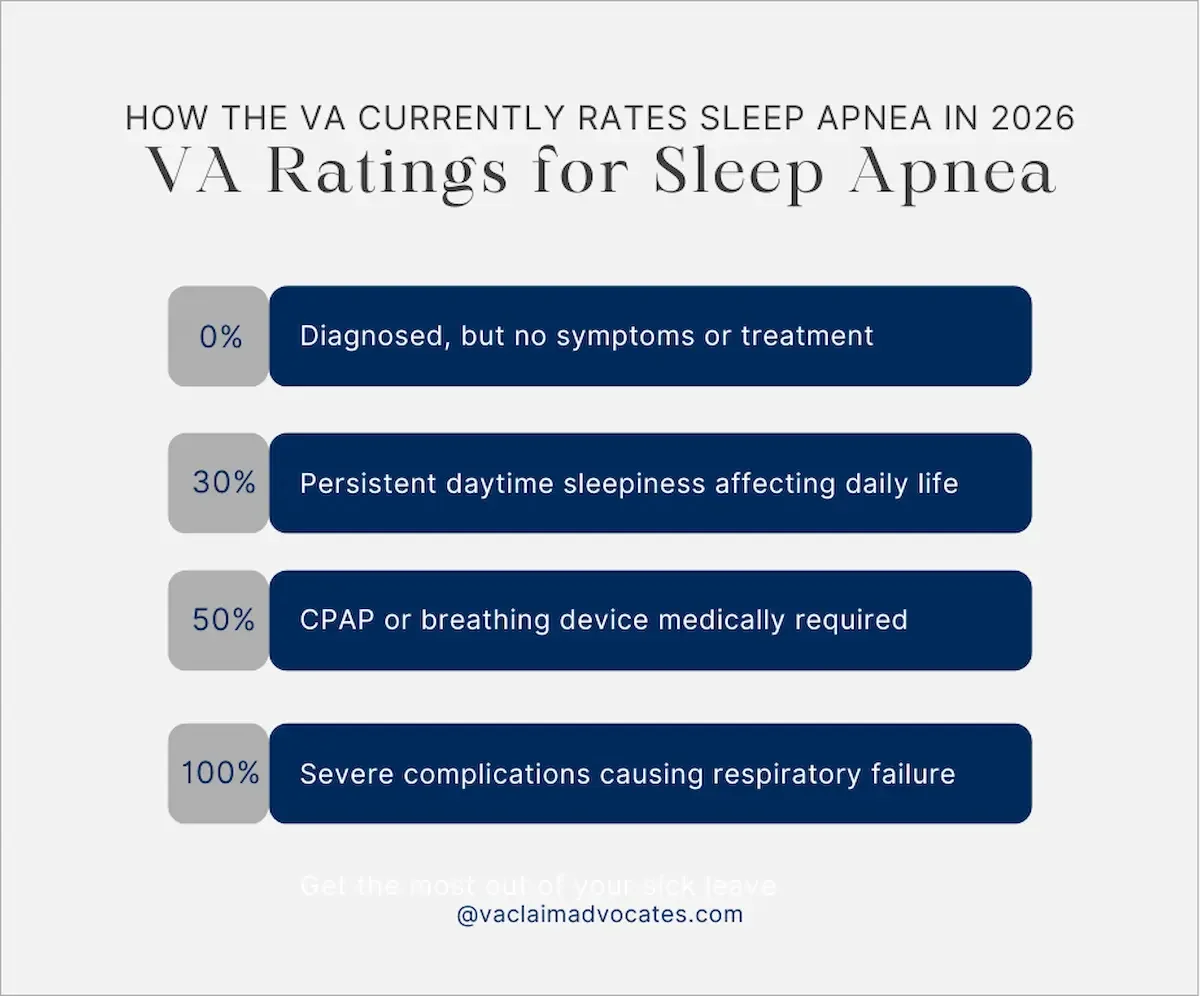
The VA rates sleep apnea under Diagnostic Code 6847 using four possible percentages: 0%, 30%, 50%, and 100%.
Your rating is based mainly on your symptoms and the level of treatment required, not just your diagnosis.
0% Rating: Diagnosed but No Symptoms or Treatment
A 0% rating means the veteran is service connected for sleep apnea, but they don’t currently have the symptoms or treatment required for compensation.
Many veterans are rated at 0% even though they meet the criteria for a higher rating.
Common VA errors include:
Ignoring CPAP prescriptions already in the medical record
Relying only on the C&P exam and not reviewing treatment notes
Not considering documented daytime symptoms
The best thing to do is check your decision letter to make sure the VA addressed all of these factors.
30% Rating: Ongoing Daytime Sleepiness
A 30% rating is assigned when sleep apnea causes persistent daytime hypersomnolence, which simply means excessive daytime sleepiness that affects daily functioning.
The VA looks for real-world impact, not just general tiredness.
Good examples of daytime sleepiness include:
Falling asleep at work or during meetings
Struggling to stay awake while driving
Dozing off during conversations or social interactions
For this rating, it is important to get lay statements and buddy statements of people who have witnessed any of your symptoms.
50% Rating: CPAP or Breathing Device Required
If you are medically required to use a CPAP machine or another breathing assistance device, you automatically qualify for a 50% rating.
However, smply owning or trying a CPAP isn’t enough. The VA looks for proof that the device is medically necessary to treat your condition.
Strong ways to show CPAP requirement include:
A CPAP Prescription: Often found in sleep clinic notes, durable medical equipment orders, or VA My HealtheVet records
Documenting CPAP Use: Many machines automatically track hours of use
Doctor notes stating the CPAP is required for treatment: Not always required, but helpful in some cases
If you were rated lower despite having documented CPAP necessity, the VA likely made an error and a Higher-Level Review (HLR) is often appropriate.
100% Rating: Serious Medical Complications
A 100% rating for sleep apnea is extremely rare and only applies in cases with serious medical complications.
It is generally assigned when sleep apnea results in:
Chronic respiratory failure with carbon dioxide retention
Cor pulmonale (strain or failure of the heart caused by lung disease)
The need for a tracheostomy
A 100% rating is hard to get because it requires extreme medical complications, not just severe sleep apnea or CPAP use.
How to Maximize Your VA Sleep Apnea Rating
While the VA rating criteria for sleep apnea are fairly straightforward, many veterans still end up with lower ratings than they should because important details aren’t properly documented.
Clearly Explain CPAP Use to the C&P Examiner
During your Compensation and Pension (C&P) exam, it’s important to clearly explain how you use your CPAP machine and why it’s medically required.
The more detail you provide, the more likely the examiner is to document it correctly in your exam report, which can directly impact your rating.
This includes explaining:
That the CPAP was prescribed to treat your sleep apnea
How often you use it (for example, every night)
What happens when you don’t use it, such as worsened symptoms or poor sleep
When CPAP use is properly documented, it makes it much easier for the VA to assign the correct 50% rating.
Filing Before the Rule Changes
There have been proposed changes to how the VA rates sleep apnea, which could make it harder for veterans to receive higher ratings in the future.
Filing sooner can help ensure your claim is evaluated under the current rules.
This is important because:
Future changes may reduce how heavily CPAP use affects ratings
New criteria could require additional proof or stricter standards
Claims filed now are generally reviewed under the existing rating schedule
Because of this, many veterans choose to file as soon as they have the required evidence rather than waiting.
VA Compensation for Sleep Apnea (Monthly Payments)
The monthly compensation for sleep apnea is the same as other VA disability conditions at the same rating percentage.
However, the exact amount can vary slightly each year due to inflation and whether you have dependents such as a spouse or children.
Current VA Pay Rates for Sleep Apnea Ratings
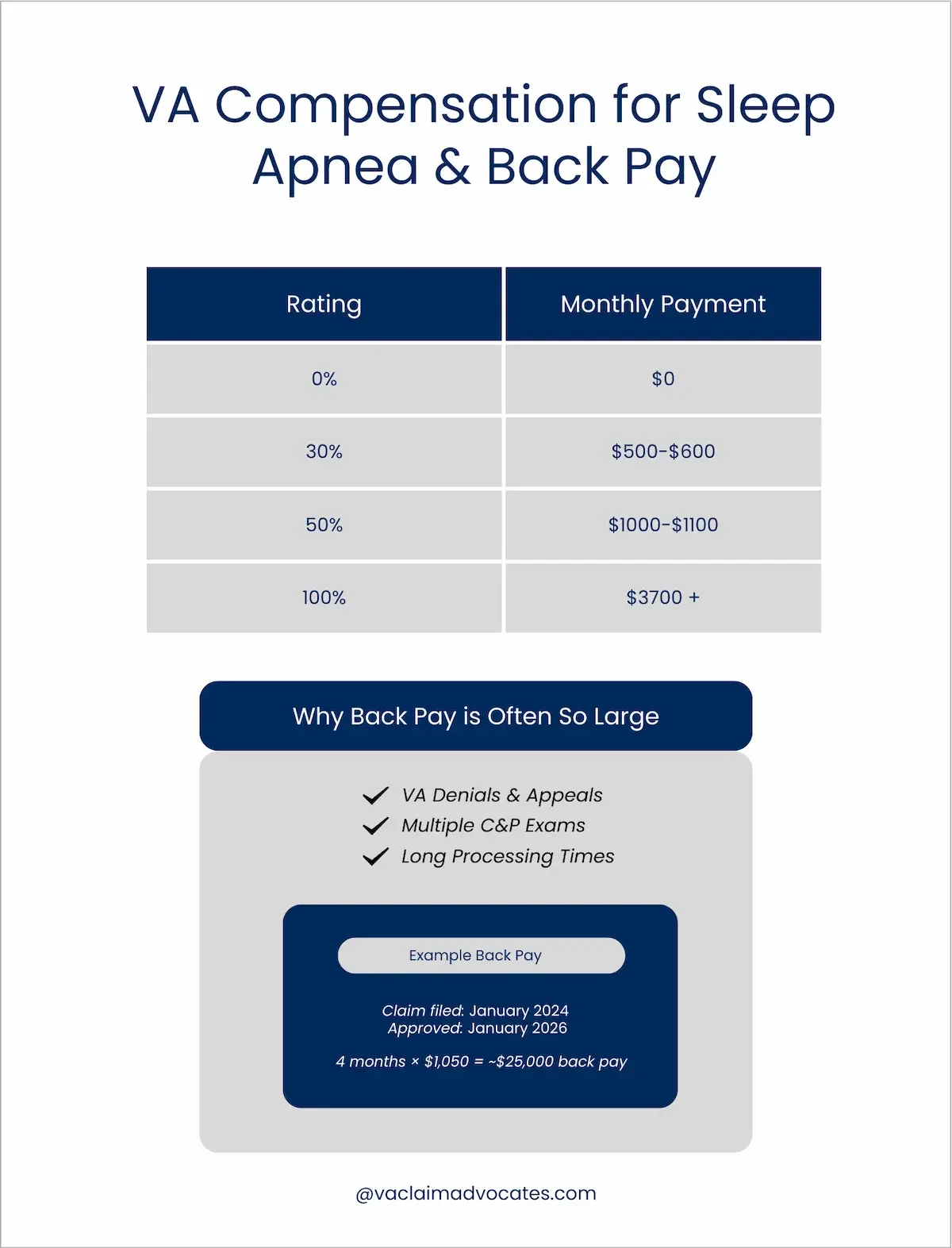
Here are the current compensation amounts for sleep apnea:
10% rating: around $180 per month
30% rating: around $500 to $600 per month
50% rating: around $1,000 to $1,100 per month
100% rating: around $3,700+ per month
These amounts typically increase by a few percent each year to account for inflation, and veterans with spouses or children usually receive slightly higher monthly payments.
Why Many Veterans Receive Large Back Pay Amounts
Many veterans receive large back pay amounts for sleep apnea because the claims process often takes a long time.
This is commonly due to:
Claim denials and appeals
Multiple C&P exams
Long VA processing times
Back pay usually starts from the date you filed your claim or intent to file.
Example:
If a veteran filed in January 2024 and was approved for a 50% rating in January 2026, they would receive about 24 months of back pay. At roughly $1,050 per month, that equals around $25,000 in back pay
Proposed Changes to VA Sleep Apnea Ratings
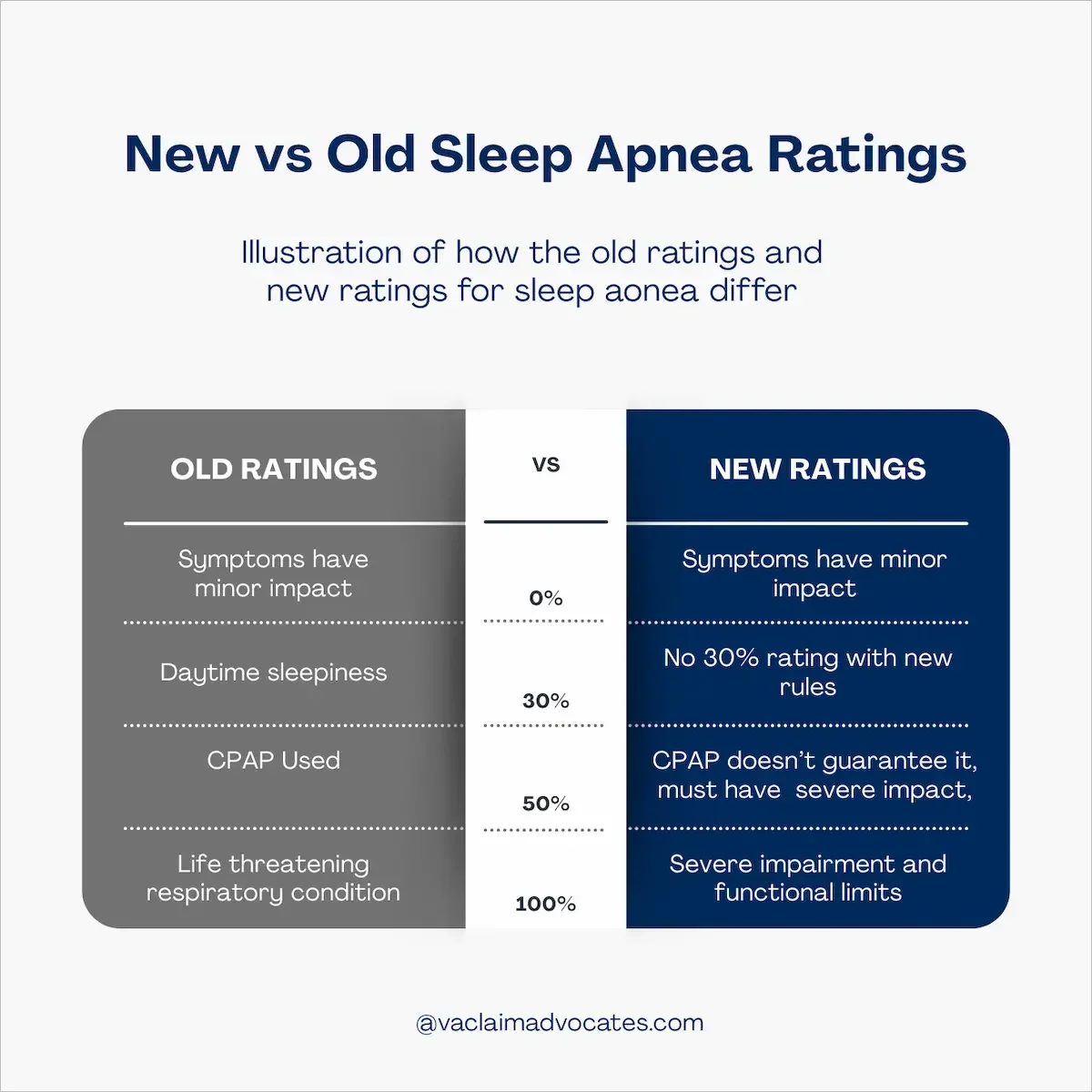
The VA has proposed new sleep apnea rating rules that would shift ratings toward overall impairment rather than treatment type.
While the rules would remove the automatic 50% CPAP rating and eliminate the 30% rating, it may potentially allow sleep apnea to be rated separately from other respiratory conditions.
These new rules also includes changes to VA ratings for tinnitus as well as PTSD
Possible Removal of Automatic 50% CPAP Rating
The VA has proposed changes that would remove the automatic 50% rating simply for being prescribed a CPAP machine.
While the exact details are still being finalized, under the proposed system veterans would generally only qualify for a higher rating in certain situations.
This could include cases where:
You cannot use a CPAP machine due to medical issues, discomfort, or intolerance that prevents effective treatment
Your symptoms do not improve with CPAP use, meaning the condition continues to cause significant impairment even with treatment
Under the current rating system, CPAP use alone typically qualifies for a 50% rating. If you file and are granted a rating before any rule changes take effect, you can still receive the 50% rating under today’s criteria.
Need Help With Your VA Claim?
Speak with a VA claims specialist to understand your options and next steps.
Call 888-820-8520Potential End of the 30% Rating Level
Another proposed change would remove the 30% sleep apnea rating entirely.
Instead of awarding 30% for persistent daytime sleepiness, the VA would shift toward evaluating how much sleep apnea limits a veteran’s overall ability to function and work, similar to how other respiratory conditions are rated.
This means fewer claims would fall into a middle category and more focus would be placed on measurable impairment.
Rating Sleep Apnea Separately From Other Respiratory Conditions
One bright side of the proposed changes that many veterans don’t talk about is that sleep apnea may be allowed to be rated alongside other respiratory conditions, instead of being limited to just one respiratory rating.
Example under the current system (pyramiding): A veteran with 30% for asthma and 50% for sleep apnea would usually only receive the higher 50% rating.
Example under the proposed system: That same veteran could potentially receive 30% for asthma + 50% for sleep apnea as separate ratings, increasing total compensation.
These changes would mainly impact veterans who have sleep apnea along with another respiratory condition like asthma, rhinitis, or chronic breathing issues.
Common Reasons Veterans Are Denied Sleep Apnea Ratings
Even when a veteran is diagnosed with sleep apnea, certain situations can limit or prevent a VA rating. Below are some of the most common ones.
You Are Already Rated 60% or Higher for Another Respiratory Condition
The VA follows a rule called pyramiding, which means you generally can’t be compensated separately for multiple respiratory conditions that affect the same body system.
In most cases, the VA will assign only one respiratory rating and use whichever condition results in the higher percentage.
This often includes conditions like:
Asthma
Chronic bronchitis
COPD
Other respiratory disabilities
Using a CPAP Before Military Service
If you were prescribed a CPAP machine before entering the military, it becomes much harder to receive a VA rating for sleep apnea.
This is because the VA may view the condition as:
Pre-existing
Not directly caused by military service
In some situations, veterans can still qualify if they can prove their sleep apnea was permanently worse than before. However, this usually requires strong medical evidence and is more difficult than a standard service connection claim.
Filing Under Old VA Rating Rules (Before 1996)
The VA’s current sleep apnea rating rules, including the 50% rating for CPAP use, did not exist before October 7, 1996.
If a claim was filed before this date:
The VA may not apply modern rating criteria
CPAP use may not qualify for a 50% rating
Because VA claims and appeals can take many years to resolve, this situation is more common than most veterans realize. VA ratings for IBS also follow a similar rule.
Key Takeaways on VA Sleep Apnea Ratings
Sleep apnea VA ratings are mainly based on symptoms and required treatment, not just a diagnosis.
While the rating chart itself is straightforward, many veterans receive lower ratings due to service connection issues or VA documentation errors.
Understanding how CPAP use, daytime sleepiness, and secondary connections work can greatly improve your chances of receiving the correct rating.
If you’re preparing a claim or appeal, making sure your medical records clearly support the rating criteria can make a significant difference.
FAQ
-
Yes, but it’s uncommon and usually only reviewed after a reexamination or new medical evidence shows CPAP treatment is no longer medically required, a sleep study shows major improvement, or the original rating was based on an error.
Simply improving with treatment does not trigger a reduction. In most cases, veterans keep their rating as long as CPAP remains part of their prescribed care
-
No, sleep apnea is not a presumptive condition for most veterans, meaning it is not automatically assumed to be service connected.
The main exception is when sleep apnea was clearly diagnosed or documented during active duty, such as through an in-service sleep study or medical records showing symptoms and treatment.
In those cases, veterans may qualify through direct service connection rather than needing to prove a secondary link.
-
In most cases, this happens because the VA made an error or the C&P examiner failed to properly document CPAP use in the exam report. This can often be corrected by filing a Higher-Level Review (HLR) and pointing out where the CPAP prescription appears in your medical records.
However, using a CPAP alone does not automatically qualify you for a 50% rating. The VA looks for proof that the CPAP is medically required to treat your sleep apnea.
Submitting evidence of a formal CPAP prescription along with documented consistent use in a supplemental claim can greatly improve your chances of receiving the correct rating.
-
Most veterans prescribed a CPAP receive a 50% sleep apnea rating, but it isn’t guaranteed.
The VA looks for proof the CPAP is medically required, so including your prescription and documented use helps ensure the correct rating.
-
Most sleep apnea claims take about 3 to 6 months when the evidence is clear and exams are completed on time.
More complex claims, such as appeals, can often take 6 months or longer.