Nexus Letter for Sleep Apnea: What the VA Really Looks for
Sleep apnea claims are some of the most frustrating in the entire VA system—and most veterans don’t realize just how critical a nexus letter is until they’ve already been denied.
Even worse, many veterans spend hundreds of dollars on a nexus letter, only to receive a vague rejection that never explains what went wrong.
Here’s the good news: getting a nexus letter for sleep apnea that actually works is far easier than most veterans think.
This guide breaks down exactly how to get a nexus letter for sleep apnea, why most veterans need one, and how to make sure your letter is strong enough to be approved.
Do You Need a Nexus Letter for Sleep Apnea?
For the vast majority of veterans, a nexus letter is essential for winning a VA sleep apnea claim because the condition is usually granted as a secondary disability and requires medical explanation to connect it to service
Why Most Sleep Apnea Claims are Secondary
Sleep apnea is usually caused or worsened by another service-connected disability, which means it’s typically filed as a secondary condition. Most of the time, you need a nexus letter to prove secondary service connection. This is because of:
Many Alternative Causes — Sleep apnea has lots of possible non-service causes, so a nexus letter clarifies why yours is tied to a service-connected condition.
Medical Complexity — Because sleep apnea is complex and requires formal diagnosis, an expert needs to explain how the secondary link makes medical sense.
Delayed Diagnosis — Most veterans aren’t diagnosed until years later, so a nexus letter explains why the delay still supports a secondary connection.
Because of all these factors, connecting sleep apnea to your service can be difficult, which is why a nexus letter is often essential.
Why C&P Examiners Often Deny Sleep Apnea
C&P examiners see so many sleep apnea claims that they often become dismissive, treating them as low-credibility cases unless the evidence is airtight.
Overlooking Aggravation: Oftentimes, veterans have pre-existing sleep apnea that was made worse by their service, but examiners rarely acknowledge this and instead dismiss it as a simple pre-existing condition.
Skimming Evidence: Examiners often review records too quickly and miss important nuances.
They Default to Non-Service Factors”: Unless a clinician explains why weight, age, or anatomy are not the primary cause, the examiner will assume they are.
Limited Medical Awareness: Examiners aren’t always familiar with certain medical links, so you should never assume they’ll recognize the connection on their own.
If the examiner says “less likely than not,” VA raters almost never override that without a strong, detailed, specialist-backed nexus letter that explains why the examiner is wrong.
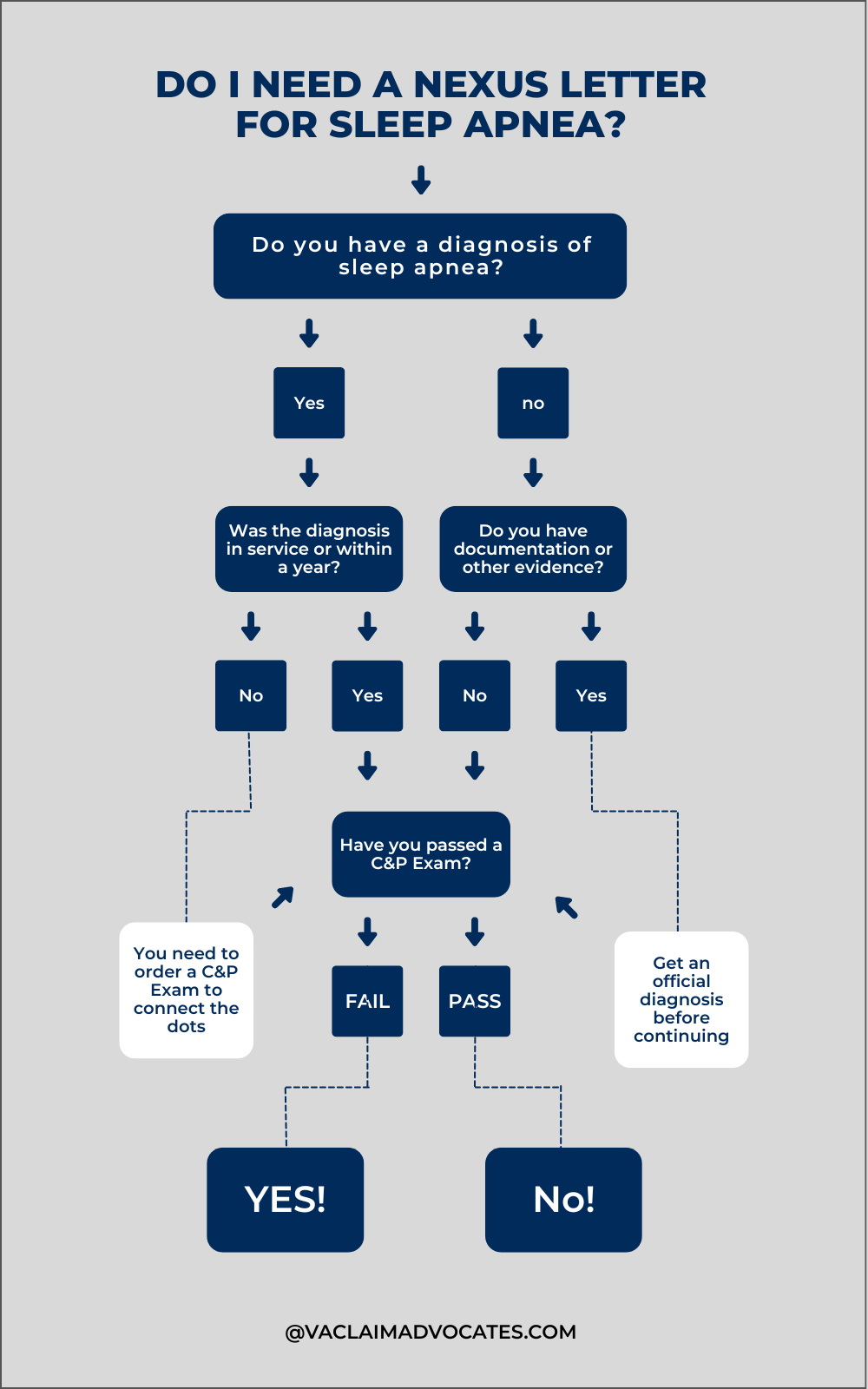
Rare Cases When You Don’t Need a Nexus Letter
In a few situations, a nexus letter is helpful — but not absolutely required. These are rare, but important to understand.
You most likely only qualify for direct service connection if you meet ALL criteria:
Diagnosis & Sleep Study Within a Year of Service: If you had a sleep apnea diagnosis through a sleep study issued during or within the first year after discharge, you may not need a nexus because the timeline is naturally tight.
In Service Documentation: If your service records show snoring, choking/gasping at night, upper airway obstruction ENT evaluations. These aren’t enough evidence alone, but helpful support overall.
No Pre-Existing Sleep Apnea: If you had pre-existing sleep apnea that worsened, you must get a nexus letter proving it got measurable worse.
No matter which pathway applies, you must have a confirmed sleep apnea diagnosis from a sleep study for the VA to grant service connection.
How A Nexus Letter Proves Your Sleep Apnea is Service Connected
A sleep apnea nexus letter must clearly explain the medical mechanism linking the condition to service and why that explanation is more likely than other causes.
In addition, some conditions are harder to link to sleep apnea than others. For example, a nexus letter can link sleep apnea to tinnitus, but it a is extremely complex and difficult to win.
Mental Health Conditions Linked to Sleep Apnea
Several mental health conditions can lead to sleep apnea as a secondary disability, some of which include:
PTSD – medications and hyperarousal can cause weight gain and fragmented sleep.
Depression – antidepressants often contribute to metabolic changes and airway collapse.
Anxiety disorders – chronic hyperventilation and sleep fragmentation reduce upper-airway stability
These connections are possible, but ONLY when you point to the specific mechanism linking mental health to obstructive sleep apnea—not the condition itself.
Bad Link: “PTSD/mental health caused my sleep apnea.”
Good Link: “SSRIs, antipsychotics, and mood stabilizers prescribed for PTSD and depression commonly cause significant weight gain, which increases upper airway narrowing and contributes to OSA onset.”
Respiratory Conditions Linked to Sleep Apnea
Several respiratory conditions can cause or worsen obstructive sleep apnea, especially when they impact nasal airflow or increase airway resistance. These include:
Sinusitis – chronic inflammation blocks the nasal passages and forces mouth breathing.
Rhinitis – congestion and swollen tissues raise nasal resistance during sleep.
Asthma – airway inflammation and restricted airflow destabilize nighttime breathing.
Never assume the VA understands these connections, you must supply the medical literature yourself.
Bad Link: “Sinusitis caused my sleep apnea.”
Good Link: “Chronic nasal obstruction from sinusitis leads to mouth breathing, which destabilizes the airway and increases collapse—supported by Li et al. (2005, American Journal of Rhinology).”
One important thing to note is that if you’re already service connected for a respiratory condition rated at 60% or higher, you usually won’t receive a separate VA rating for sleep apnea.

Who Should Write Your Sleep Apnea Nexus Letter
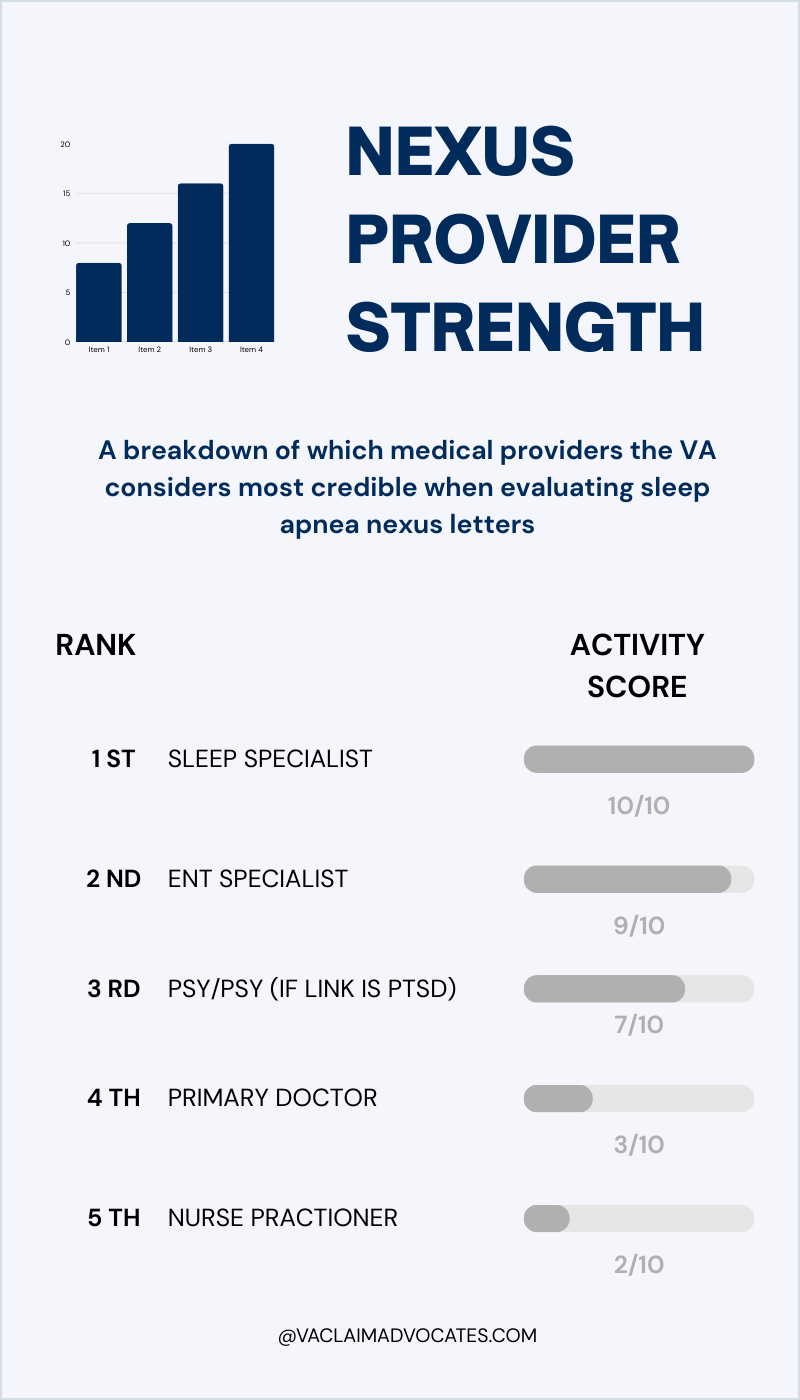
Sleep apnea nexus letters carry the most weight when written by qualified specialists who understand airway mechanics, sleep disorders, and VA medical standards.
Best Providers to Write it
Sleep-related specialist: A provider trained in diagnosing and treating sleep disorders—such as a sleep medicine physician, pulmonologist, or ENT.
Specialist in the primary condition you’re linking it to: A clinician who treats the service-connected condition (like a psychiatrist for PTSD connection) and can medically explain how that condition caused or aggravated your sleep apnea.
A nexus from one of these providers doesn’t guarantee approval, but it’s the standard for a strong claim.
Providers to Avoid
The VA does not forbid any provider from writing a nexus letter, but opinions from general practitioners almost always carry very little weight for sleep apnea claims.
Primary care doctor: PCPs rarely specialize in sleep disorders or secondary medical pathways, so their letters often lack the detailed medical rationale the VA requires.
Nurse practitioner: NP opinions are frequently discounted because they typically do not provide specialist-level explanations of airway obstruction, sleep architecture, or contributing conditions.
If you have a good relationship with your PCP or Nurse Practitioner, it is worth asking if they can recommend you to a specialist.
How to Get a Nexus Letter for Sleep Apnea
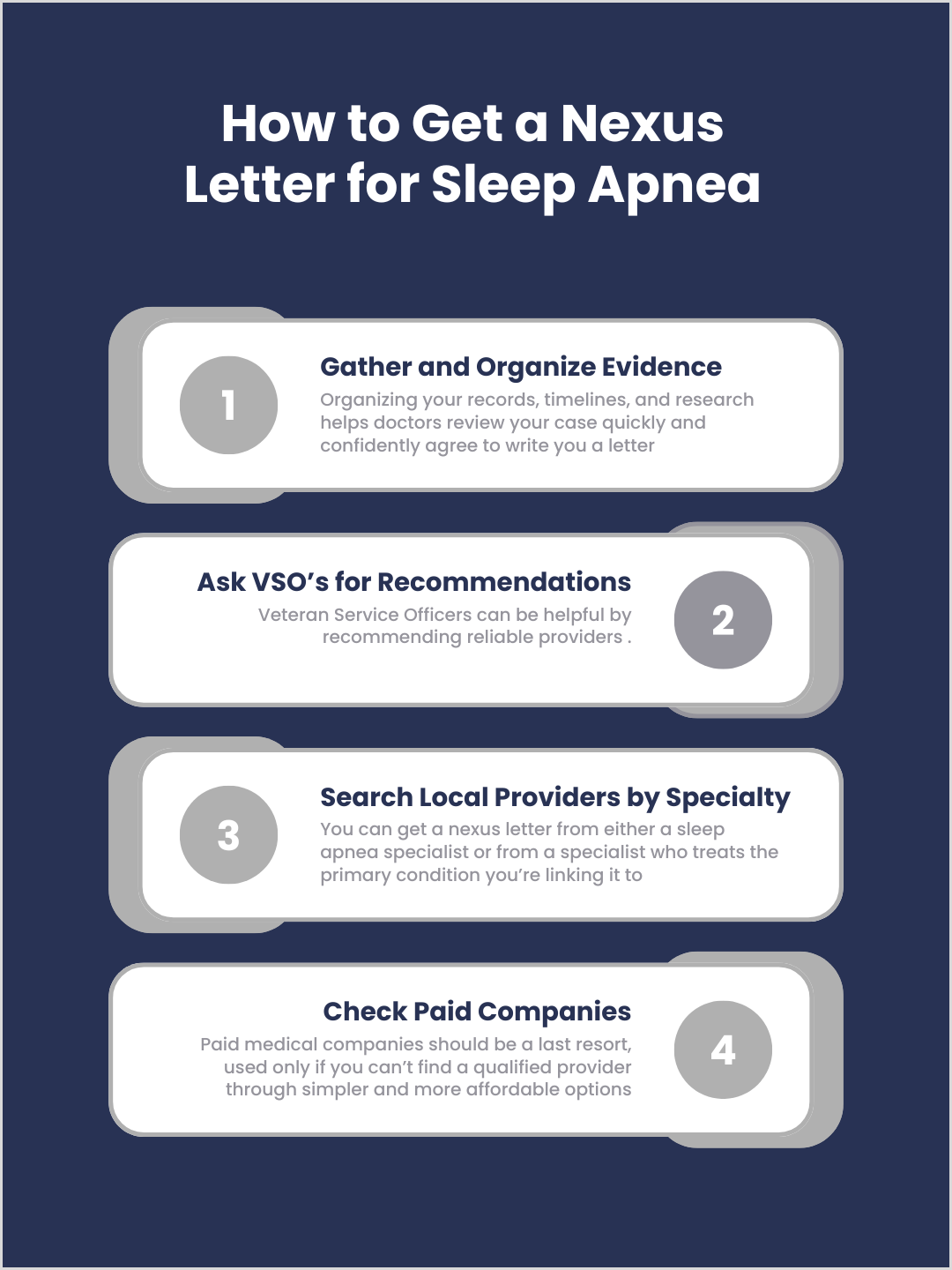
Getting a strong nexus letter for sleep apnea usually requires preparation, persistence, and approaching the right type of provider with organized medical and service records.
Step 1: Gather Evidence
Doctors are far more willing to help when you give them everything they need up front. Prepare a short packet that includes:
Your sleep study results (AHI score, oxygen levels, CPAP recommendation)
A summary of why you believe your apnea is connected
Relevant service treatment records
Records of your service-connected conditions
Medication history (especially if weight gain is a factor)
Any past C&P exams or rater notes that need clarification
Step 2: Ask Your VSO for Recommendations
VSOs cannot write nexus letters, but many of them know local clinicians who are familiar with VA disability standards. They may be aware of:
Sleep specialists who have experience with VA claims
Mental-health providers who understand PTSD-related apnea
ENTs or pulmonologists who are veteran-friendly
Local clinics that commonly treat veterans
Not all VSOs have recommendations, but asking costs nothing — and when they do know someone, the referral is usually solid.
Step 3: Find Local Sleep Specialists
If your treating provider and VSO can’t help, the next step is to search local sleep specialists.
Here are the best directories to use depending on your condition:
Sleep Apnea Specialist Directories:
American Academy of Sleep Medicine (AASM): “Sleep Center” & “Sleep Doctor” finder
American Board of Sleep Medicine (ABSM): provider directory
Your state’s “Board of Medicine”: search (look for pulmonologists, ENTs, sleep physicians)
You can also search for directories related to the condition you re claiming is secondary to sleep apnea.
Step 4: Paid Nexus Services (Use with Caution)
As a true last resort, you may consider companies that offer paid nexus letters. Some veterans have succeeded this way, but for sleep apnea — a medically complex condition — this approach is generally discouraged.
If you explore this option, make sure the provider:
Is a licensed medical professional
Reviews all of your records (not just a questionnaire)
Understands your specific secondary condition
Provides a detailed medical rationale
Uses the “at least as likely as not” standard
Does not guarantee approval or advertise guaranteed outcomes
Do not contact paid nexus companies until you’ve fully exhausted your options with qualified local providers.
What Ever Sleep Apnea Nexus Letter Must Include
A sleep apnea nexus letter must interpret the sleep study, demonstrate a thorough understanding of the veterans claim, and clearly explain the medical reasoning connecting the condition to service.
What is a Nexus Event for Sleep Apnea?
A nexus event isn’t always a single moment or incident — it’s the contributing factor that medically links your sleep apnea to your service.
Most of the time, this factor is another service-connected condition (like PTSD, sinusitis, or rhinitis), but it can also be something that happened in service that later affected your airway or sleep stability.
In short, the nexus event is the medical reason your sleep apnea exists today because of your service
Essential Nexus Elements for Sleep Apnea
Interpret the Sleep Study: The nexus writer must explain your AHI score, oxygen drops, and why CPAP or an oral appliance was medically necessary — not just mention the study.
Address Alternative Causes: They must explain why common causes the VA assumes (weight, age, anatomy, lifestyle) do not fully explain your sleep apnea, or why your service-connected condition is more medically likely.
Rebut C&P Examiner Assumptions: The letter should directly address any prior examiner’s statements, especially generic phrases like “multifactorial” or “not caused by,” and explain why those conclusions were incomplete.
Provide a Clear Symptom Timeline: The nexus must outline when symptoms began, how they progressed, and how they align with the onset or worsening of your service-connected condition.
Explain Why CPAP Was Required: Instead of simply stating you use a CPAP, the provider must explain why your clinical findings required CPAP therapy and how this supports the claimed link.
Cite Relevant Medical Literature: Strong nexus letters reference research that supports the relationship between the two conditions.
A simple guideline: Every claim made in the nexus letter must be supported by medical reasoning or documentation.
Need Help With Your VA Claim?
Speak with a VA claims specialist to understand your options and next steps.
Call 888-820-8520Why Sleep Apnea Claims Get Denied Even with a Nexus Letter
Many sleep apnea claims are denied because the nexus letter lacks medical depth, fails to explain causation or aggravation, or does not address the VA’s common denial assumptions.
Missing Confirmed Sleep Apnea Diagnosis
You already know a sleep study is required for service connection, but it’s worth repeating. The VA can discount your nexus letter If there isn’t a clear diagnosis of a condition
Make sure the provider clearly states:
Your diagnosis
The date of the sleep study
The type of test used
You don’t need to overwhelm them with every detail, but it’s always better to include too much information than too little.
Not Including Medical Research
This is the single biggest mistake veterans make: providing either no medical literature or articles that are irrelevang.
You must do your own research here, you cannot understand an article from the title alone. Make sure to:
Read the full article: Don’t rely on titles—make sure the content actually applies to your case.
Credible source: Use studies from reputable medical journals, not blogs or summaries.
Explains the medical mechanism: The article must show how your condition leads to sleep apnea, not just that they’re “related.”
Weak or Unproven Medical Link
Not every service-connected condition has a strong medical connection to sleep apnea.
Tinnitus is a classic example. A nexus letter can help many tinnitus claims, but not for sleep apnea, there’s virtually no medical evidence linking the two.
Plantar fasciitis – musculoskeletal pain, but no effect on airway structure or sleep physiology.
Migraines – may co-occur with sleep disorders, but not known to cause sleep apnea.
Low back pain – can contribute indirectly through reduced activity and weight gain, but requires very specific evidence and is often denied.
If you’re unsure whether your claimed pathway has been approved before, you can search Board of Veterans’ Appeals decisions to see how others argued the connection
Relying Too Much on Lay Statements
Lay statements can describe symptoms—snoring, choking, gasping—but symptoms are not a diagnosis and cannot establish medical causation.
Lay statements and buddy statements should be referenced in the nexus letter, but they should never serve as the foundation for proving the connection.
Strong Nexus Letter Example for Sleep Apnea
This section shows exactly what strong nexus letter examples look like and how medical reasoning, evidence quality, and language directly affect VA approval outcomes.
“I am Dr. Smith and I am writing this letter on behalf of the veteran.”
“I am Dr. Smith, a board-certified sleep medicine specialist with 18 years of experience treating obstructive sleep apnea. I have reviewed the veteran’s sleep study, C&P Exam results, medication history, and service-connected conditions.”
“The veteran snores and has trouble sleeping.”
“Symptoms began in 2014 following chronic sinusitis. His spouse documented nightly choking episodes and severe fatigue interfering with work and driving until his 2019 sleep study confirmed OSA.”
“Military service is the most likely cause.”
“Weight and anatomy were evaluated but do not explain onset. ENT imaging shows sinus obstruction tied to the veteran’s service-connected sinusitis, making it the stronger medical explanation.”
“I disagree with the examiner.”
“The prior examiner did not consider aggravation or review 2017 ENT imaging showing airway obstruction. These omissions make the opinion medically incomplete.”
“The veteran says his symptoms began after service.”
“Spouse and coworker statements confirm nightly apneas and daytime sleepiness during documented sinusitis flare-ups, supporting the medical timeline.”
“Sleep apnea is related to sinusitis.”
“Chronic sinusitis causes nasal obstruction leading to mouth breathing, which increases airway collapsibility — the primary mechanism of obstructive sleep apnea.”
“It is at least as likely as not related.”
“Given his chronic nasal obstruction, progressive symptoms, consistent lay evidence, and research linking nasal resistance to OSA, it is at least as likely as not that his sinusitis caused or aggravated his sleep apnea.”
How Much a Sleep Apnea Nexus Letters Costs
The cost of a sleep apnea nexus letter varies widely based on the provider, level of preparation, and whether the veteran gathers evidence independently.
However, you can significantly reduce the cost by doing a lot the preparation yourself, as mentioned above.
Here’s a general breakdown of the price range:
Low-Cost ($0–$150): Letters may be this cheap if you find a local provider and spend a few weeks doing research and preparation.
Moderate Cost ($150–$600): This is typically what you can expect from online specialists. However, this is far superior to hiring an online company
High-Cost ($600–$2,000+): When hiring a professional nexus-letter service to do all the work for them.
I recommend that you exhaust your option before paying a company for a letter. They are highly inconsistent with quality and you may just get denied anyway.
Final Thoughts on Sleep Apnea Nexus Letters
Winning a sleep apnea claim almost always comes down to the strength of your nexus letter.
When the provider clearly explains the medical mechanism, addresses alternative causes, cites research, and ties everything back to your service-connected conditions, your chances of approval increase dramatically.
If you take the time to gather your records, organize your evidence, and choose the right specialist, getting a strong nexus letter is far easier—and far cheaper—than most veterans realize.
Use the guidance in this article as your roadmap, and you’ll give the VA exactly what it needs to finally take your sleep apnea claim seriously
FAQ
-
If you can’t find a provider to write a sleep apnea nexus letter, start by exhausting all local options, asking VSOs for recommendations, and speaking with your VA doctors for guidance. If none of those work, you may need to consider a paid nexus service—but only as a last resort. Research any paid company thoroughly to make sure the provider is licensed, credible, and actually reviews your records
-
A nexus letter for sleep apnea does not guarantee approval—it simply strengthens your case by providing the medical explanation the VA needs. The VA will still weigh your records, sleep study, symptoms, and alternative causes before making a decision. A strong nexus letter improves your odds, but it can’t override weak evidence or missing documentation
-
It varies, but generally the conditions that require the most detail are the ones with weaker or less-established medical links to sleep apnea. Issues like PTSD, chronic pain, GERD, and medication-related weight gain need far more explanation and literature than strongly supported pathways like rhinitis or sinusitis
-
A strong nexus letter can overrule a negative C&P exam, but only if it provides clearer reasoning, stronger evidence, and better-supported medical literature than the examiner’s opinion. The VA weighs all medical opinions based on detail and rationale, so a well-written nexus letter can carry more weight than a weak or poorly supported C&P exam.
-
Sometimes — but only in rare cases. If you had a sleep study and diagnosis during service or within one year of discharge, you may be approved without a nexus letter. For nearly everyone else, especially with delayed diagnosis, a nexus letter is essential because the VA won’t connect sleep apnea to service without a medical explanation