Can VA Doctors Write Nexus Letters? What Most Veterans Miss
If you’ve ever asked your VA doctor for a nexus letter and been told no, the frustration is understandable.
After all, VA doctors are the ones treating your condition and should be the most qualified to give a medical opinion.
Since they also have a duty to assist veterans, it feels like this should be an easy yes.
Instead, they often say no, which pushes veterans toward limited or expensive options that don’t always work.
If any of this resonates, I completely understand and have been there myself. In this guide, I explain why VA doctors commonly refuse to write nexus letters and why it’s usually based on misunderstanding, not an actual prohibition.
More importantly, I show how you can often get a free nexus letter from your VA doctor by preparing your case properly, approaching the request the right way, and handling objections.
Are VA Doctors Actually Required to Write Nexus Letters?
VA doctors do have an obligation to help veterans get a nexus letter, but they are not required to personally write a favorable nexus opinion.
What VA Policy Actually Requires of VA Doctors
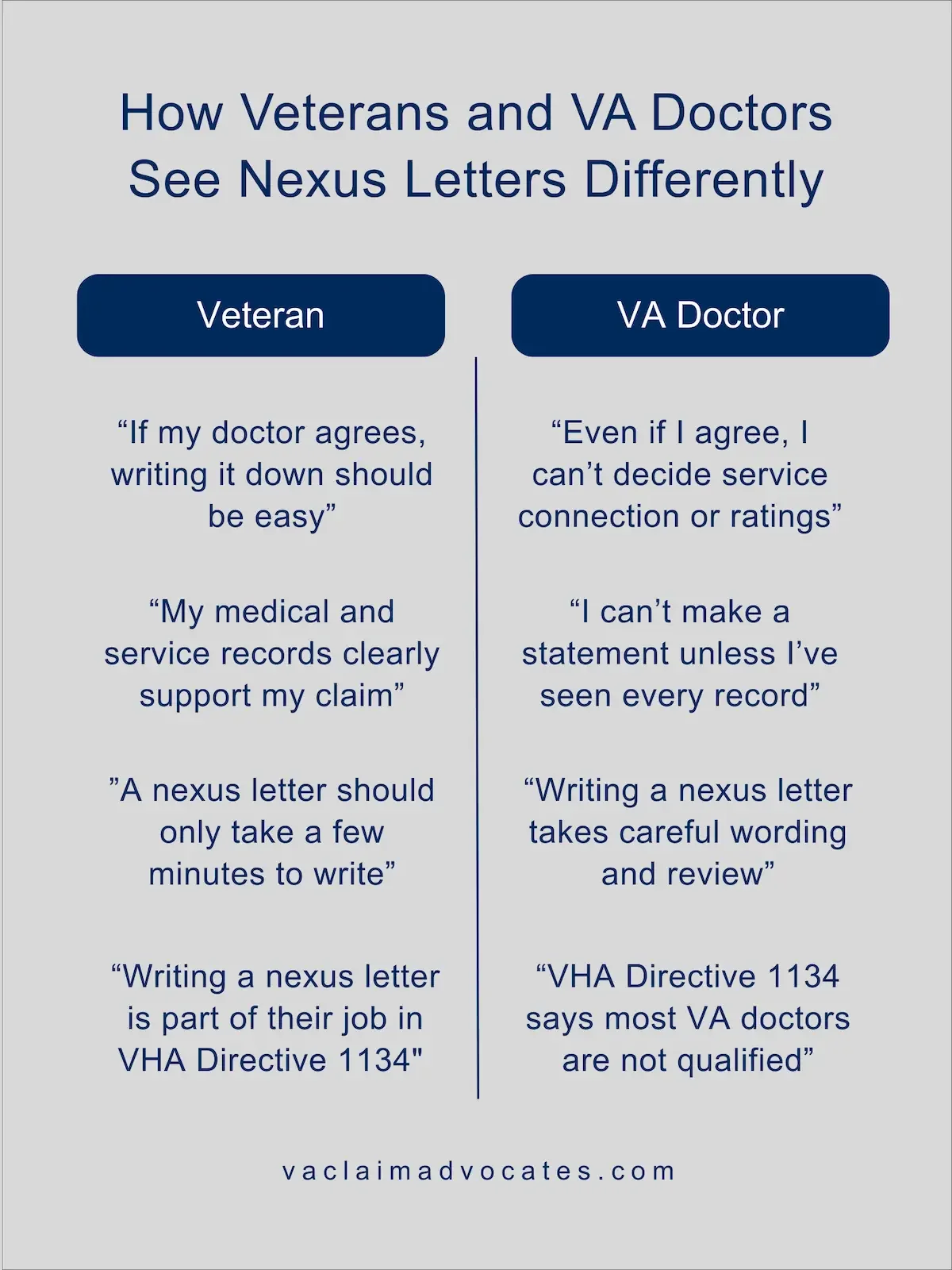
Under VHA Directive 1134, VA doctors are required to assist veterans in filling out or helping veterans get the necessary medical evidence for their claim.
Here’s what it says:
“When honoring requests for medical statements by Veterans for VA claims adjudication, care must be taken to avoid conflict of interest or ambiguity.”
On the surface, this does not appear to be a strict rule against VA doctors writing nexus letters. However, the next section explains what VA doctors should be cautious of.
Why VA Guidance Warns Doctors About
Immediately after the statements allowing VA doctors to fill out private opinions (nexus letters), the directive follows with:
“Service connection and disability ratings for VA benefits are purely legal determinations belonging exclusively to the Veterans Benefits Administration (VBA).”
This matters because a medical opinion is just that, an opinion, it reflects medical judgment and does not make a final legal determination
The directive then states:
“VHA providers often do not have access to military medical records, and may not be familiar with all the health issues specific to military service.”
To provide a well-supported medical opinion, a VA doctor needs a clear understanding of the veteran’s relevant medical and service history.
Because military medical records are stored separately and are not automatically included in VA health care charts, providers cannot always access that information.
Why Most VA Doctors Say No to Writing Nexus Letters
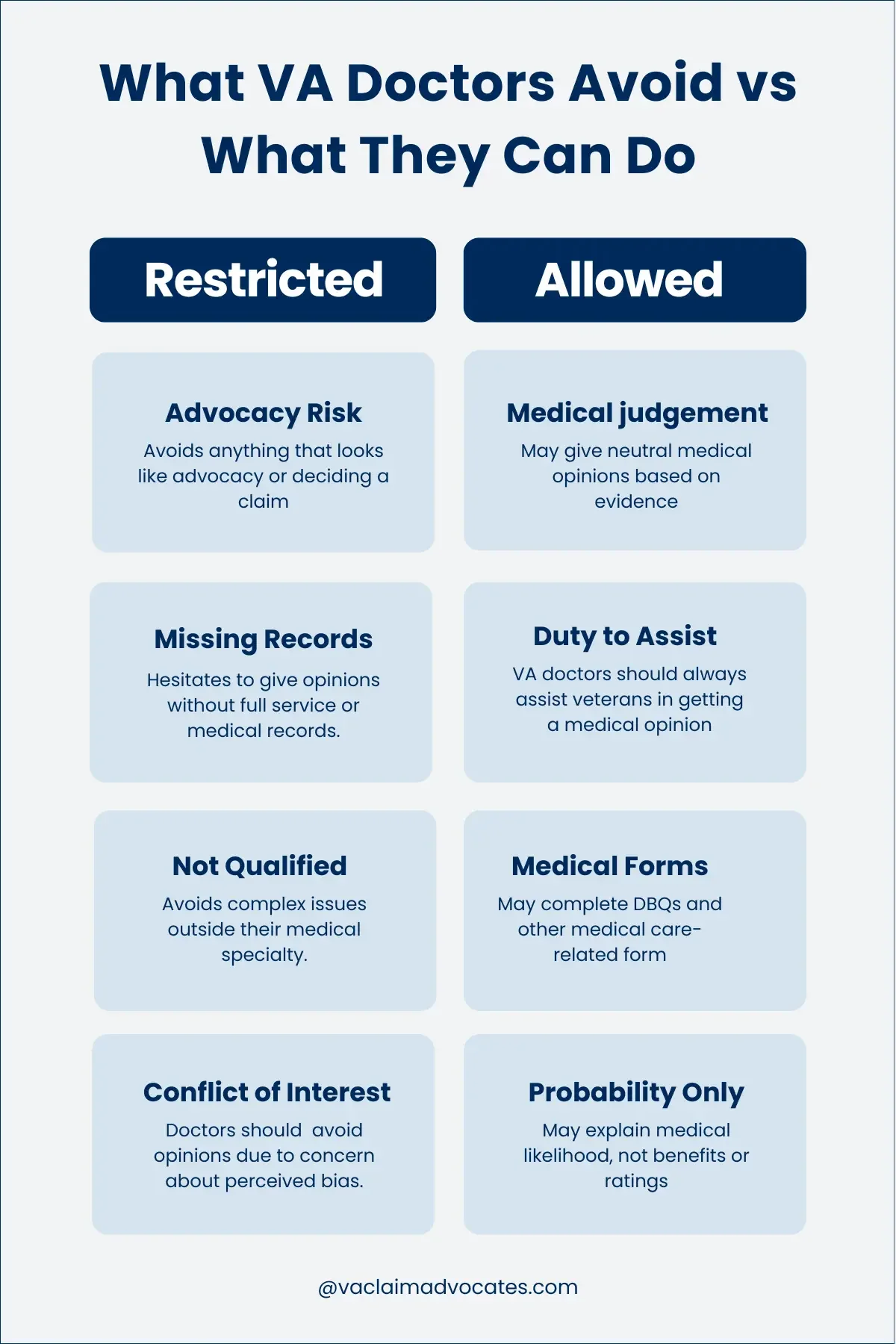
VA doctors often refuse to write nexus letters not because they are prohibited, but because training, institutional culture, and how VA guidance is applied make doing so feel risky or outside their role.
This usually creates hesitation, even when a doctor believes the medical connection is legitimate.
Fear of Risk and Institutional Pressure
Many VA doctors are told that writing nexus letters exposes them to legal or professional risk.
To avoid this “legal risk” VA providers are trained to:
Document conservatively
Avoid language that could be misinterpreted
Stay within clearly defined clinical/medical role
VA doctors often view nexus letters as a legal task that falls outside their defined medical role. I will discuss exactly why in a few sections.
Misunderstanding of “Conflict of Interest”
Conflict of interest is often misunderstood. Some VA doctors assume that because they work for the VA, they cannot provide a medical opinion that helps a veteran without creating a conflict.
In reality, a conflict of interest does not exist simply because:
The provider is employed by the VA
The opinion may be used in a VA benefits claim
The opinion could support the veteran’s position
A conflict exists only when a medical opinion:
Is influenced by bias rather than medical judgment
Is written without adequate evidence or record review
Is framed as advocacy instead of an independent clinical assessment
Later, I will explain exactly how to phrase your request so they don’t take your request as a conflict of interest.
They View Nexus Letters as Legal, Not Medical
A nexus letter is simply a medical opinion from a doctor, but it is often treated as a legal document instead of a clinical assessment.
However, many VA doctors perceive them differently for a few common reasons:
Unfamiliar terminology: The term “nexus letter” is not standard clinical language and is unfamiliar to many providers, even though the concept itself is a routine medical opinion.
Claims and benefits association: Nexus letters are closely associated with VA claims, benefits decisions, and legal outcomes rather than day-to-day medical care.
Perceived legal requirements: Many providers believe nexus letters require specific phrasing or legal precision beyond a normal medical opinion.
Some veterans have shared that simply using the term “nexus letter” changed the tone of the conversation with their provider, even though the request was for a routine medical opinion.
Writing a Nexus Letter Takes a lot Time
VA doctors often decline nexus letters because they believe writing one will require a large investment of time
Many providers assume that preparing a nexus letter means they need to:
Review extensive service and medical records
Develop detailed medical reasoning
Research and cite medical literature
VA doctors already heavy patient loads and strict documentation requirements, so taking on that level of work can feel impractical.
How to Respond When a VA Doctor Pushes Back
Many objections VA doctors raise are based on misunderstandings about what a nexus letter is and what their role would be in providing one.
In many cases, those concerns can be addressed by responding calmly, clarifying the request, and avoiding legal or confrontational language
“I’m not allowed to write nexus letters.”
I generally advise veterans to ask for a medical opinion rather than using the term “nexus letter,” even though they are functionally the same thing.
In many cases, it helps to avoid the term “nexus letter” altogether, since it can sound legal rather than clinical.
Asking for a medical opinion based on the doctor’s treatment of you and their medical judgment often feels more aligned with their role and responsibilities.
“That’s outside my scope.”
This objection is sometimes legitimate, especially when a general provider is asked to address complex medical causation or secondary conditions outside their routine practice.
Other times, it reflects training that encourages providers to avoid opinions requiring specialized expertise.
When this comes up, keep the response simple:
Explain you are not asking for an exhaustive or definitive opinion
Clarify that you are only seeking their medical judgment based on treating you
Emphasize that they can limit the opinion to what they feel comfortable stating
Even a limited opinion can still help your claim, especially if they treated you directly.
Need Help With Your VA Claim?
Speak with a VA claims specialist to understand your options and next steps.
Call 888-820-8520“I don’t have time to review all of that.”
In most cases, the relevant information doctors need to write a nexus letter can be summarized in one to two pages.
I often encourage veterans to prepare a brief, organized summary that highlights the medical question being asked and the records that matter most.
This could include:
A strong example of a nexus letter for guidance
Relevant medical literature they can reference
The service and medical records that actually matter
When VA doctors see that they do not need to review endless records and are provided with a clear summary of the relevant evidence and medical reasoning, they are often far more willing to help.
“I don’t get involved in claims.”
The best way to handle this is gently clarify up front that you are not asking them to decide service connection, benefits, or ratings.
You are only requesting their medical judgment based on their treatment of you and the records they rely on.
This is separate from how the VA ultimately decides service connection or ratings for the claim.
How Your VA Doctor Can Still Help You Get a Nexus Letter
Even if your VA doctor will not personally write a nexus letter, that does not mean they cannot help you get one.
In many cases, their assistance behind the scenes is what makes a strong medical opinion possible later.
Other Medical Evidence Your VA Doctor May Provide
Even if a VA doctor will not write a full nexus letter, a brief medical statement can still carry significant weight.
At a minimum, it helps establish medical facts in the record and can support a stronger opinion later.
If they are unwilling to write a full opinion, they may still be willing to:
Confirm your diagnosis
Document symptom history and onset
Note functional limitations
These smaller pieces of evidence often become the foundation for a nexus letter written by another provider.
Getting Help Finding the Right Doctor to Write the Opinion
VA providers are often one of the best resources for helping you find a doctor who can write a nexus letter.
VA doctors often know which specialists handle your condition most often, whether a referral is appropriate, and what type of expertise the VA expects for certain conditions.
Being seen by the right specialist can carry more weight than an opinion from a provider who feels the issue is outside their scope.
How to Move Forward If You Still Need a Nexus Letter
VA doctors can provide medical opinions, and in many cases they are allowed to state whether a condition is at least as likely as not related to service.
When a VA doctor refuses, it’s usually not because they are legally prohibited, but because the request feels unclear, legal, or outside their role.
That doesn’t make the experience any less frustrating. Being turned away by the doctor who knows your medical history often pushes veterans toward expensive alternatives that don’t always help, or leaves them feeling stuck in the process.
If you’re unsure how to approach your VA doctor again or want guidance based on your specific situation, you can reach out to us to better understand your options and next steps.
FAQ
-
VA nurse practitioners can write nexus letters, but they are often hesitant due to concerns about legal liability and conflicts of interest.
Your chances improve significantly if you organize the relevant information into a clear one or two-page evidence summary and provide straightforward guidance on what is being requested.
Even if they agree to help, nurse practitioners may not be the best option for complex or secondary conditions, but they can be effective for more straightforward claims
-
Doctors with an ongoing treatment relationship, such as primary care providers, are often more willing to help than specialists who see veterans infrequently or only for procedures.
Because they manage overall care and have access to long-term medical records, they are usually more comfortable offering a medical opinion when it’s framed clearly and kept within their clinical role.
-
Even if a VA doctor refuses to write the opinion itself, they can often still assist you in other ways. Veterans can ask for a brief medical statement, supportive treatment notes, or a completed DBQ, all of which can still carry evidentiary weight.
You can also ask the provider to help point you toward an appropriate specialist or explain what type of medical opinion would be most helpful for your claim.
-
Yes. VA doctors are generally allowed to complete DBQs, especially when the form relates to a condition they actively treat.
DBQs focus on documenting diagnosis, symptoms, and functional impact rather than deciding service connection, which is why many VA providers are more comfortable completing them than writing a nexus lette
-
Whether a VA doctor is willing to write a nexus letter often comes down to individual interpretation, comfort level, and workload rather than a clear rule.
Some providers understand that a nexus letter is simply a medical opinion, while others mistakenly believe it places them in the role of deciding a claim or creates legal risk.