5 Legit Ways Veterans Get Free Nexus Letters
If you have ever looked up the cost of nexus letters, the prices can be shocking. Some companies charge up to three thousand dollars, and even then the quality is unpredictable.
This leaves many veterans wondering whether getting a nexus letter is worth it at all or if they should just give up.
The truth is that getting a free, high-quality nexus letter is often much easier than people think, it just comes down to using the right approach.
In this article, I explain five proven ways to find a doctor willing to write a nexus letter for free so you can get your VA benefits no veteran should have to pay for.
Can Veterans Really Get a Nexus Letter for Free?
Yes, many veterans can get a nexus letter for free, and the process is often simpler than it seems.
When doctors say no, it is usually not because they are unwilling to help, but because reviewing extensive medical and service records and writing a nexus letter using VA standards takes time they often do not have.
These concerns can often be addressed by preparing a clear, concise request.
While veterans cannot write a nexus letter themselves, they can do much of the preparation, which makes doctors more willing to help at no cost.
The five legitimate ways veterans most commonly obtain a free nexus letter:
These represent the most realistic and commonly successful options when a doctor is willing to provide a medical opinion at no cost.
- A long-term primary care doctor
- A VA treating physician
- Requesting a medical opinion instead of a “nexus letter”
- Specialists already treating the condition
- Expanding outreach beyond a single clinic or city
Preparation & Organization: The Single Biggest Factor
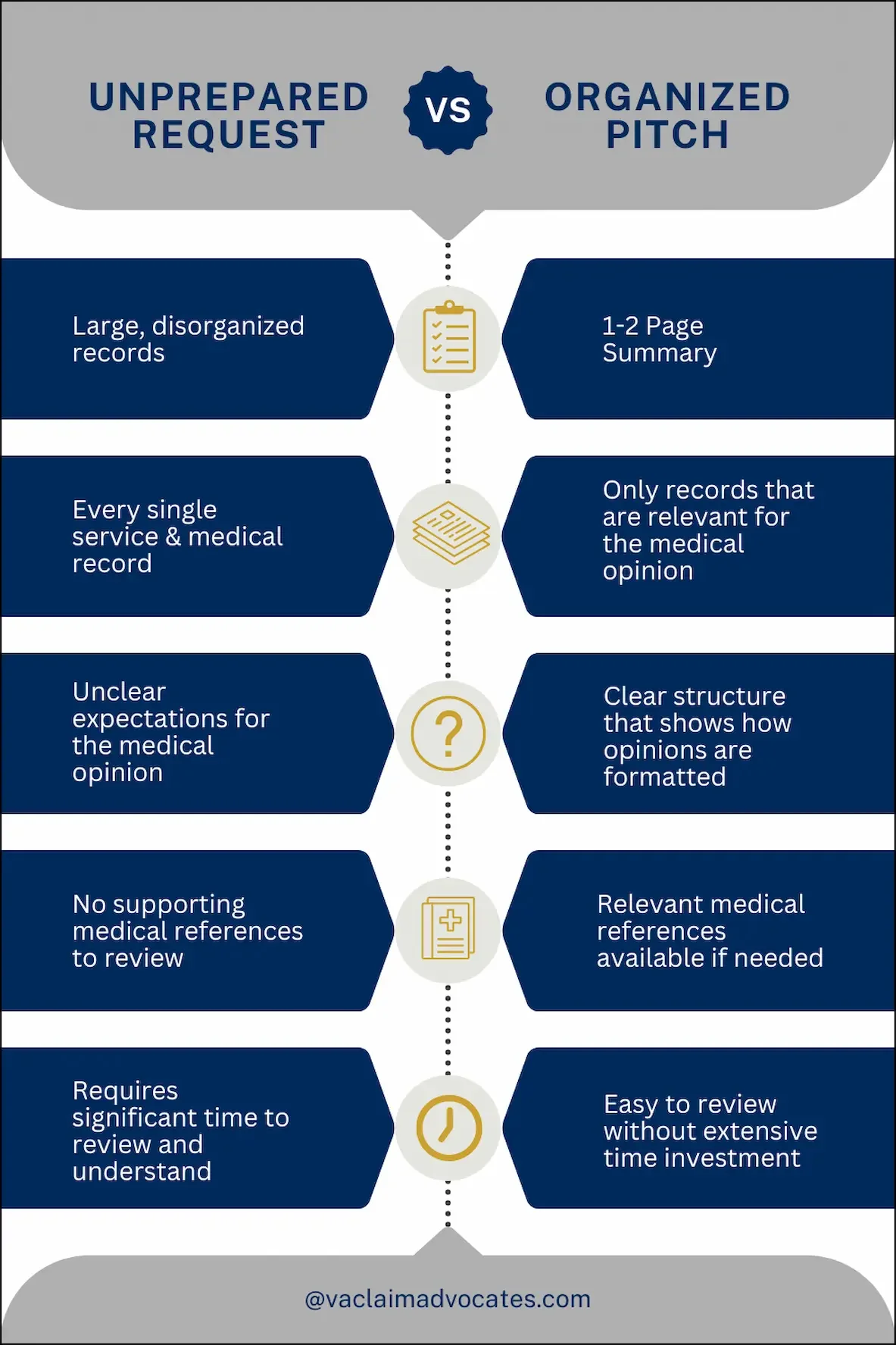
Organize your VA claim so a doctor understands it with minimal effort. Use a one to two page summary that states the purpose, includes a nexus letter template, and lists only relevant records.
Doctors are less likely to charge for their time when they don't have to spend so much effort into understanding your claim.
Use a Clear Medical Opinion Format
The goal is to give the docrtor a clear, familiar structure for expressing a medical opinion.
Veterans should provide a format outline only, showing:
How the opinion is organized
What elements the VA looks for
Where the doctor can explain their own reasoning
This helps the doctor focus on evaluating the evidence, not figuring out how to word the opinion.
The conclusions, language, and medical judgment must remain entirely the doctor’s own.
Include Only the Evidence That Actually Matters
Doctors are far more willing to help when the evidence is concise and relevant, not buried in hundreds of pages.
Veterans should include a short section—often labeled “Evidence Reviewed”—listing only the materials the doctor may need to reference, such as:
Lay or Buddy Statements: Briefly note what they describe and how they support the claimed connection.
Service Records: Focus on records that document symptoms, events, exposures, or timelines relevant to the condition.
Medical History: Highlight prior diagnoses, progression of symptoms, and any potential pre-existing or alternative causes the doctor may need to consider.
This section is supporting material, not the focus. The primary emphasis should always remain on the medical opinion format, with evidence available only if the doctor chooses to reference it.
Why Primary Care Doctors Are Often the Best Free Option
Doctors who have treated you over time already understand your medical history and have an established relationship with you.
When they trust your account and can easily review the relevant evidence, they are often more willing to provide a medical opinion for free.
Why Ongoing Treatment Makes Doctors More Willing to Help
Doctors who have treated you over time are often one of the strongest options for a free nexus letter because it feels like helping a patient, not a legal transaction.
This typically works best when:
They’ve Treated You Long Enough: Ongoing care means they’re already familiar with your medical history, symptoms, and progression.
You’ve Built Rapport: This doesn’t have to be complicated. When a doctor knows you and trusts your account, they naturally want to help you.
They’ve Treated the Condition Itself: When the opinion is based on a condition they’ve actually managed, there’s less resistance because it reflects firsthand medical judgment.
Because the opinion is grounded in an existing treatment relationship, these types of doctors are more comfortable providing it at no cost.
When Primary Doctors Are Less Likely to Write for Free
The truth is that not all Primary Doctors will be willing to write you a nexus letter for free.
This approach may be less effective when:
Frequent Doctor Changes: When care is inconsistent, doctors have less familiarity with your history and are less comfortable providing an opinion without additional effort.
Complex Medical Conditions: Complicated cases require more time to review records, understand causation, and form a defensible medical opinion, which is when doctors often expect compensation.
Unorganized Evidence: Even primary care doctors don’t have time to sift through extensive records. When evidence isn’t clearly organized, the request feels time-intensive and less likely to be handled for free.
In most cases, the difference comes down to preparation. When your case is clear and easy to understand, doctors are far more willing to help without charging for their time.
Why VA Doctors Are Often A Free Option (Yes, Really)
VA doctors are often willing to help with nexus letters for free because assisting veterans they treat is part of their job.
Despite a common belief, VA doctors can be willing to write a nexus letter when you approach them in a way that removes legal hesitation.
They’re Expected to Assist With Medical Evidence
VA doctors are a strong free option because:
Assisting veterans with medical documentation is already part of their role
The VA’s duty to assist includes helping obtain medical opinions
They are not being asked to decide the claim or advocate legally
A properly framed request fits within normal clinical responsibilities
The key distinction is language. Medical opinion is a familiar, appropriate request. Nexus letter is a term veterans use—often associated with paid services and legal responsibility—that can create unnecessary resistance.
There is No Financial Incentive to Charge Money
VA doctors are often a good option for free nexus letters because money usually isn’t part of the decision for them.
Salaried, Not Fee-Based
VA doctors are salaried employees and don’t get paid extra for writing medical opinions.Different From Private Providers
Private doctors often bill separately for record reviews or written opinions, while VA doctors do not.
Because there’s no separate fee involved, willingness typically depends on time, comfort, and familiarity with your case rather than cost.
Requesting a Medical Opinion Instead of a Nexus Letter
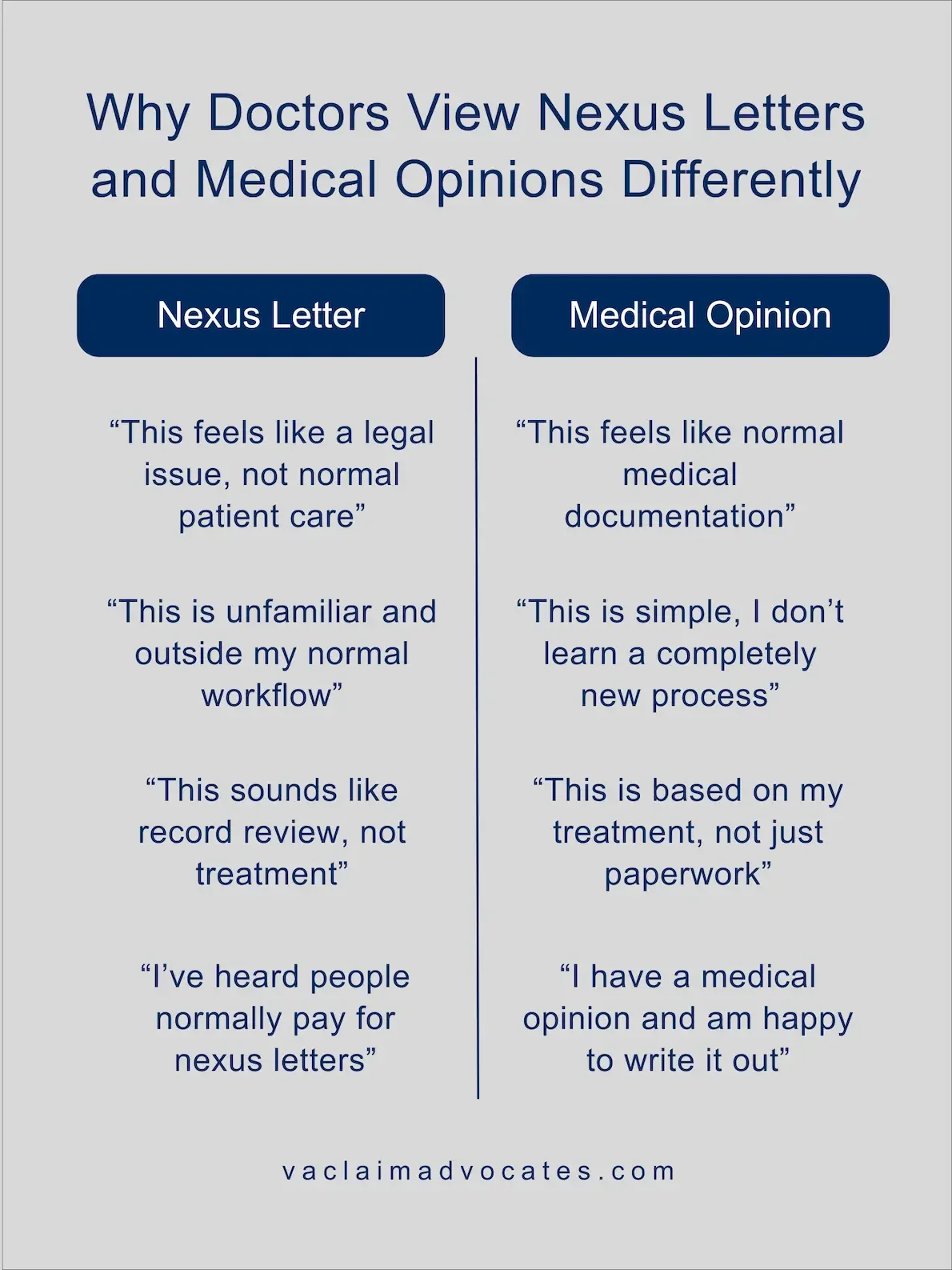
To many doctors, the term nexus letter carries baggage that has nothing to do with medicine. While the VA treats nexus letters and medical opinions the same in practice, they can feel very different to a provider.
A “nexus letter” is often associated with:
Paid companies or third-party services
Legal responsibility or advocacy
Transactional requests outside normal care
A medical opinion is viewed as:
A routine part of clinical practice
Non-transactional and non-legal
Focused purely on medical judgment
Because of this difference, some doctors are uncomfortable writing something labeled a nexus letter but are completely willing to provide a medical opinion about causation or aggravation.
Specialists Already Treating Your Condition
Specialists are often strong free options because they are trained experts in the condition itself.
When a doctor has already diagnosed, evaluated, or documented your condition through treatment, a medical opinion usually builds on work they have already completed.
Specialists Who Diagnosed Your Condition
When a specialist has diagnosed your condition, much of the work required for a medical opinion is already done.
Diagnosis typically involve:
Examining records
Ordering tests
Forming professional
Medical conclusions.
Because the specialist’s diagnosis is based on direct evaluation and clinical evidence, an opinion about cause or aggravation does not require speculation.
It simply explains whether the condition they identified could be related to service based on their medical judgment.
Doctors Who Have Already Completed a DBQ or Medical Statement
Doctors who have already completed a DBQ or written a medical statement have effectively engaged in VA-style medical documentation.
In doing so, they have already:
reviewed relevant records
documented symptoms or severity
applied medical reasoning within a VA claim context
A nexus letter in these cases often asks the doctor to explain why a condition exists or how it relates to service, rather than how severe it is.
Because the underlying medical reasoning overlaps, providing a medical opinion is often a continuation of work already performed.
Need Help With Your VA Claim?
Speak with a VA claims specialist to understand your options and next steps.
Call 888-820-8520Reaching Out to Multiple Doctors Increases Your Odds
Finding a free nexus letter often requires reaching out to more than one doctor. Some veterans find a free option quickly, while others need to reach out to several doctors before finding one who is comfortable assisting at no cost.
Why There Are Many Possibilities
Many veterans increase their chances by looking beyond a single clinic or immediate geographic area. Qualified doctors are not limited to one city, and availability can vary widely depending on practice type and specialty.
Doctors do not always need to evaluate you in person to provide a medical opinion. In these cases, preparation becomes especially important.
When your information is organized, the request feels lower pressure and easier to say yes to.
Where Veterans Can Find Options
This matters even more for veterans with limited local options. In those cases, expanding beyond a single clinic or city can significantly increase the pool of qualified providers.
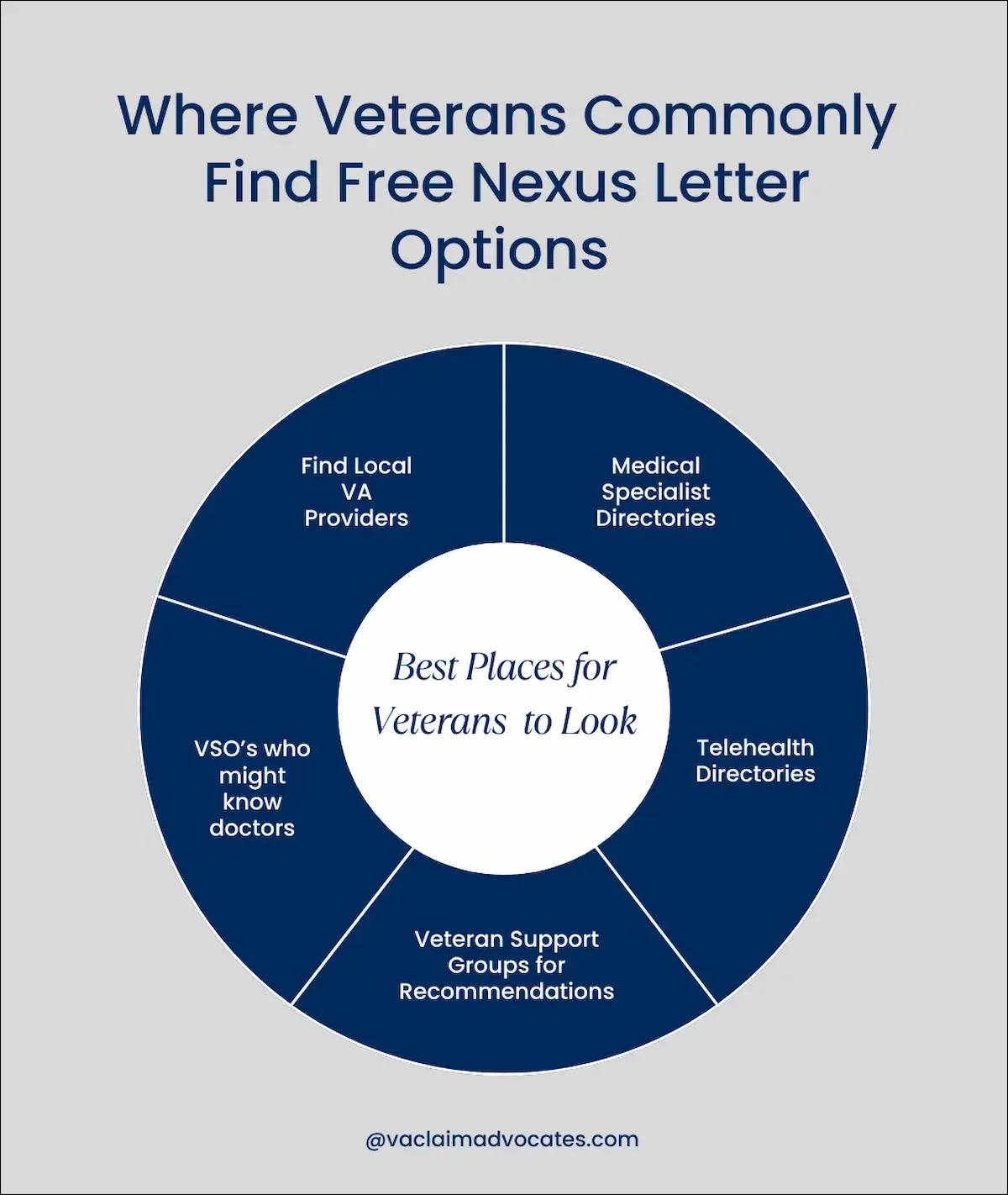
Availability often depends on specialty and practice type, not just geography. Common places veterans explore include:
VA health system providers: VA doctors outside your immediate clinic who treat similar conditions.
Nonprofit and VSO networks: Organizations that regularly work with veterans and may know doctors willing to help.
Telehealth-friendly practices: Providers comfortable reviewing records and offering opinions without an in-person exam.
Expanding your options only helps if your case is easy to review. Clear preparation makes this extremely effective.
What Ruins This Approach
Reaching out to multiple doctors doesn’t mean contacting everyone indiscriminately. This approach tends to fail when requests feel rushed, unfocused, or overly burdensome.
It’s much less effective when:
The request isn’t targeted to doctors familiar with the condition
Too much irrelevant information is provided
The medical question isn’t clearly defined
The outreach feels transactional rather than clinical
When preparation is lacking, even doctors who might otherwise help often hesitate.
Final Thoughts on Free Nexus Letters
With all the noise, conflicting advice, and outright misinformation online, getting a free nexus letter can feel far more complicated than it should be.
The reality is that success usually comes down to having a clear strategy from the very beginning and following it consistently.
Knowing how to prepare your evidence, how to approach the request, and how to avoid common mistakes makes a major difference. If you need help navigating this process or understanding your options, contact us today.
FAQ
-
Sometimes. Paid nexus letters may be worth it for complex secondary claims or when detailed medical reasoning is needed and free options have been exhausted.
If you hire a company, research them carefully and look at forums to see whether other veterans have had a good epxerience. In most cases, you’ll get the best value by paying a doctor who has actually treated you.
-
Primary care doctors are often the most likely because they know your medical history and have an established relationship with you.
Other doctors who have treated your condition including those who provided diagnoses DBQs or VA care may also be willing to help when the request fits within normal clinical care
-
It often depends on how complex the case is, how confident the doctor feels in giving a medical opinion, and how willing they are to help their patient.
In some situations, timing and chance also play a role, and finding the right doctor can come down to luck.