
VA Migraine Disability Ratings: Get the Right Percentage
Getting a disability rating for migraines often feels far more complicated than it should be.
Many veterans live with severe, debilitating pain that most people could not imagine, yet still receive a 0% rating after a negative C&P exam or a technical misunderstanding in their file.
The VA does not rate migraines based on how miserable you feel. Instead, ratings are based on the number of prostrating attacks you have and whether those attacks disrupt your ability to work.
If you do not clearly distinguish between a bad migraine and a true prostrating event, the VA will often rate you too low.
This guide explains how the VA evaluates migraines and how to structure your evidence so examiners can clearly see that you meet the criteria for the correct percentage.
Key Takeaways
Quick Summary of VA Migraine Ratings
- Prostrating attacks drive your rating. Migraine ratings are based on the average number of prostrating attacks per month, not how painful your migraines feel.
- Prostrating means you cannot function. A prostrating headache forces you to stop normal activity. Severe pain alone is not enough if you can still function.
- Consistency wins claims. Your migraine log, personal statement, buddy statements, and DBQ should all reflect the same frequency and level of work impact.
- C&P exams carry significant weight. The C&P exam often has the greatest influence on your rating, and proper preparation directly affects the outcome.
- Bad migraine vs prostrating event matters. If you do not clearly separate routine migraine days from true prostrating episodes, the VA may rate you too low.
- Treatment is not the rating criteria. Medications, Botox, and nexus letters support your claim, but your percentage depends on frequency and functional impairment.
How VA Disability Ratings for Migraines Work
The VA rates migraines almost entirely based on how often you have prostrating attacks, not how painful your migraines feel in general. The rating levels are 0%, 10%, 30%, and 50%, and each one is tied to frequency and impact.
Official VA Criteria for Migraines (Diagnostic Code 8100)
Under 38 CFR 4.124a, Diagnostic Code 8100, the VA rates migraines based on three core factors:
Frequency – How often you have prostrating attacks.
Functional shutdown – Whether the migraine forces you to stop normal activity.
Work impact – Whether the attacks cause severe economic inadaptability.
Terms like prostrating and severe economic inadaptability are broad and not clearly defined in the regulation. We will explain exactly how the VA applies them later.
VA Migraine Rating Breakdown (0%–50%)
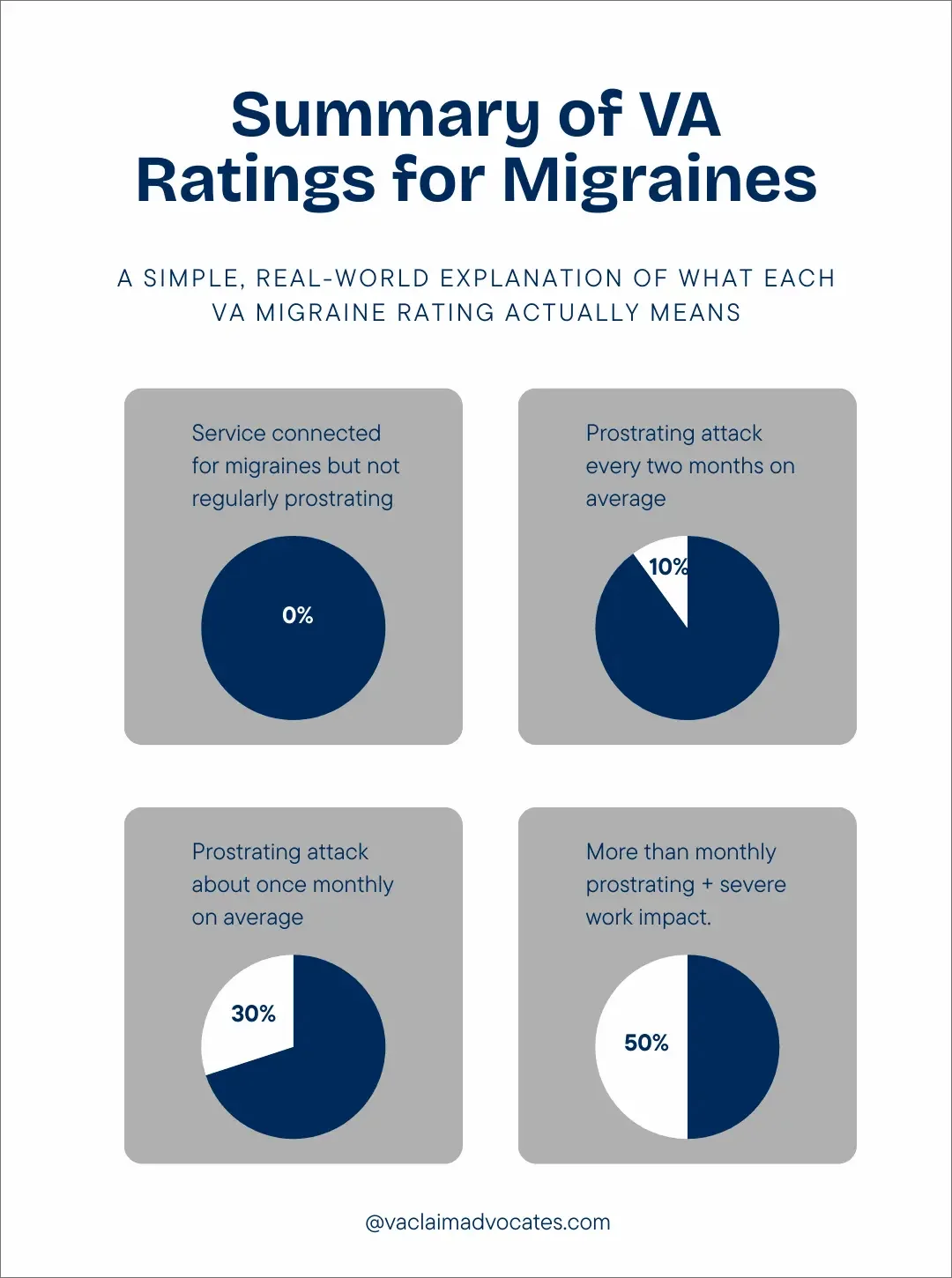
The VA currently rates migraines at 0%, 10%, 30%, and 50%. Here is a summary of the ratings below:
0% Rating: Assigned when migraines are service connected for migraines, but the evidence does not show prostrating attacks occurring at least once every two months.
10% Rating: Assigned when a veteran averages one prostrating attack every two months over several months.
30% Rating: Given when a veteran averages one prostrating attack per month and regularly forces the veteran to stop normal activity when they occur.
50% Rating: Assigned when a veteran experiences very frequent, completely prostrating and prolonged attacks that also cause significant work disruption, also described as severe economic inadaptability.
What “Prostrating” Really Means
The VA does not provide a formal definition for prostrating headaches, but it often describes them as migraine attacks that force a veteran to stop normal activity due to extreme exhaustion, powerlessness, or incapacitation.
How the VA Defines a Prostrating Attack
The first thing the VA looks for is whether the veteran’s symptoms match those commonly seen in prostrating attacks, such as:
Needing to lie down in a dark or quiet room
Nausea or vomiting
Sensitivity to light and sound
Severe, overwhelming head pain
The next thing the VA looks for is whether those symptoms make the veteran unable to function. Being forced to lie down in a dark room for hours often meets this criteria.
Prostrating Migraine vs Regular Migraine
While some migraines are extremely painful, they are only considered prostrating attacks if they make the veteran unable to function.
Here’s a simple example:
Bad Migraine: A veteran develops a migraine at work but continues working at a slower pace and finishes the day.
Prostrating Headache: Another migraine forces the veteran to stop what they’re doing, leave work, and lie down in a dark room for several hours.
While not required for a rating, prostrating events often require the veteran to take medication to ease the pain.
Bad Migraines Vs Prostrating Headaches
VA ratings hinge on prostrating attacks, not just pain severity.
- Severe head pain.
- Can push through tasks.
- Still upright and functional.
- No full shutdown.
- Must lie down.
- Dark, quiet room required.
- Unable to work or function.
- Full activity shutdown.
What “Severe Economic Inadaptability” Means for 50%
Economic inadaptability means your migraine attacks significantly disrupt your ability to function at work.
The VA considers a variety of factors that can affect your ability to work, looking at the overall impact over time rather than just a single incident.
How the VA Evaluates Work Impact
Severe economic inadaptability generally refers to a pattern of migraine-related disruptions that make it difficult to reliably perform your job, keep consistent employment, or move forward in your career.
These include:
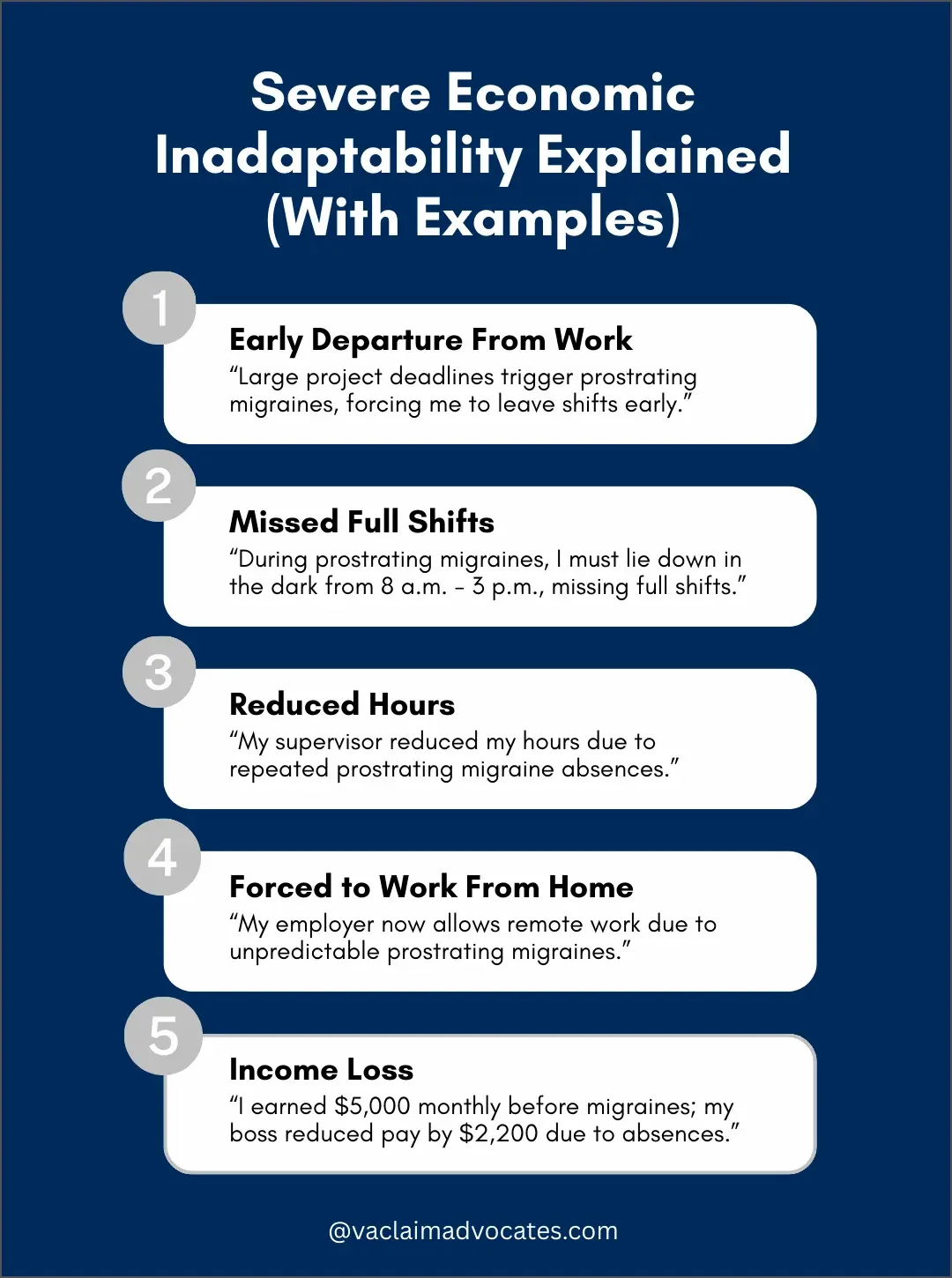
Early Departure from Work – Leaving work before completing a shift because migraine symptoms (light sensitivity, nausea, dizziness, severe pain) made you unable to function.
Reduced Productivity – Noticeable drop in work output or performance during or after migraine episodes, often reflected in reviews, warnings, or lost advancement opportunities.
Workplace Accommodations – Adjustments made by an employer (flexible schedule, remote work, reduced hours, modified environment) due to migraine-related limitations.
Income Instability – Loss of earnings, canceled appointments, reduced workload, or underemployment caused by frequent prostrating migraine attacks.
Missed Workdays – Documented full shifts missed due to prostrating migraine attacks that required you to stop all activity and lie down.
There is no exact threshold that automatically qualifies as severe economic inadaptability. The more documented examples you can provide showing how your prostrating migraines affect your work, the stronger your case becomes.
How to Clearly Describe Work Disruption
When describing how your migraines affect your job, you should explain the frequency, severity, and duration in clear, quantifiable terms.
Examples include:
Repeated missed shifts
Frequent early departures
Reduced weekly hours
Ongoing income loss
This helps the VA translate what you are experiencing into measurable, objective evidence.
Bad example: “I’ve lost hours at work because of my migraines.”
Good example: “I began working full-time (40 hours per week) in August 2022. Starting in September, I experienced at least two prostrating migraine attacks per month, which caused me to miss full shifts. In October, I was reduced 20 hours per week due to attendance issues related to my migraines.”
How to Qualify for a 50% Migraine Rating
Getting a 50% rating comes down to showing that your decreased work capacity is directly caused by your prostrating migraine attacks.
The VA needs to see a measurable link between the migraine episode and the work disruption.
Examples of strong connections include:
Work disruption occurring the same day as a prostrating attack.
Example: You develop light sensitivity and nausea at 10 a.m., leave work at noon, and miss the remainder of your shift.
Being unable to complete a specific task because of a prostrating migraine.
Example: You were scheduled to operate equipment, drive, or attend meetings but had to stop due to dizziness, vomiting, or the need to lie down in a dark room.
A supervisor statement confirming reduced hours due to migraine-related absences.
Example: Your employer documents that your weekly hours were reduced because you were missing multiple shifts per month due to prostrating migraines.
Many veterans clearly have both frequent migraines and work problems. What they often fail to show is how those two are directly connected.
Evidence You Need to Win a Migraine Claim
For a strong migraine claim, include evidence of your own experience with prostrating migraines along with statements from people who have witnessed their impact.
Most importantly, make sure all of your records and statements are consistent and do not contradict each other.
Keeping a Strong Migraine Log
A migraine log helps the VA see consistency in your symptoms over time and the patterns in how those symptoms affect your ability to function.
Your migraine log should answer these questions during migraine events:
What symptoms did you have?
How bad was the pain on a scale of 1–10?
Were you unable to function? If so, why?
How long did it last?
It doesn’t have to be long, but the VA should easily be able to tell the difference between your normal migraines and your prostrating headaches.
| Date | Symptoms | Pain (1–10) | Unable to Function? | Duration |
|---|---|---|---|---|
| Feb 10, 2026 | Light sensitivity, nausea | 8 |
Yes Left work, dark room |
4 hours |
| Feb 14, 2026 | Sound sensitivity, dizziness | 6 |
No Worked slower |
3 hours |
| Feb 18, 2026 | Nausea, vision changes | 9 |
Yes Missed full shift |
6 hours |
Writing an Effective Personal Statement
Your personal statement is your chance to clearly explain how your migraines affect your life and work.
It is often one of the most important pieces of evidence because the VA considers a veteran’s firsthand testimony highly probative when it is detailed and consistent.
A good personal statement should do the following:
Provide background on your migraines: Briefly explain when your migraines started, what caused them, and how long you’ve been dealing with them.
Describe what your normal migraines look like: Explain how your everyday migraines feel and what you can still do during them to show your baseline level of functioning.
Explain your prostrating migraine attacks with example: Describe how these episodes begin, how symptoms develop, how often they occur, and why they force you to stop normal activities. Compare them to your normal migraine days.
Walk through a single attack from start to finish to show how symptoms progress and why you were unable to function.
Buddy and Employer Statements That Help
Buddy statements are powerful because they show the VA how your migraines affect you from someone other than yourself.
There are three types of people whose statements are especially helpful:
Spouse or partner: Someone who has seen you on your worst days and can describe what happens during prostrating attacks, including how you shut down or withdraw from activity.
Employer or supervisor: A boss who can explain how migraines affect your work performance, including missed days, leaving early, reduced productivity, or schedule adjustments.
Long-term observer: Anyone who has seen you regularly over an extended period of time and can describe consistent patterns of symptoms and functional impact.
Migraine DBQ: What Makes It Strong
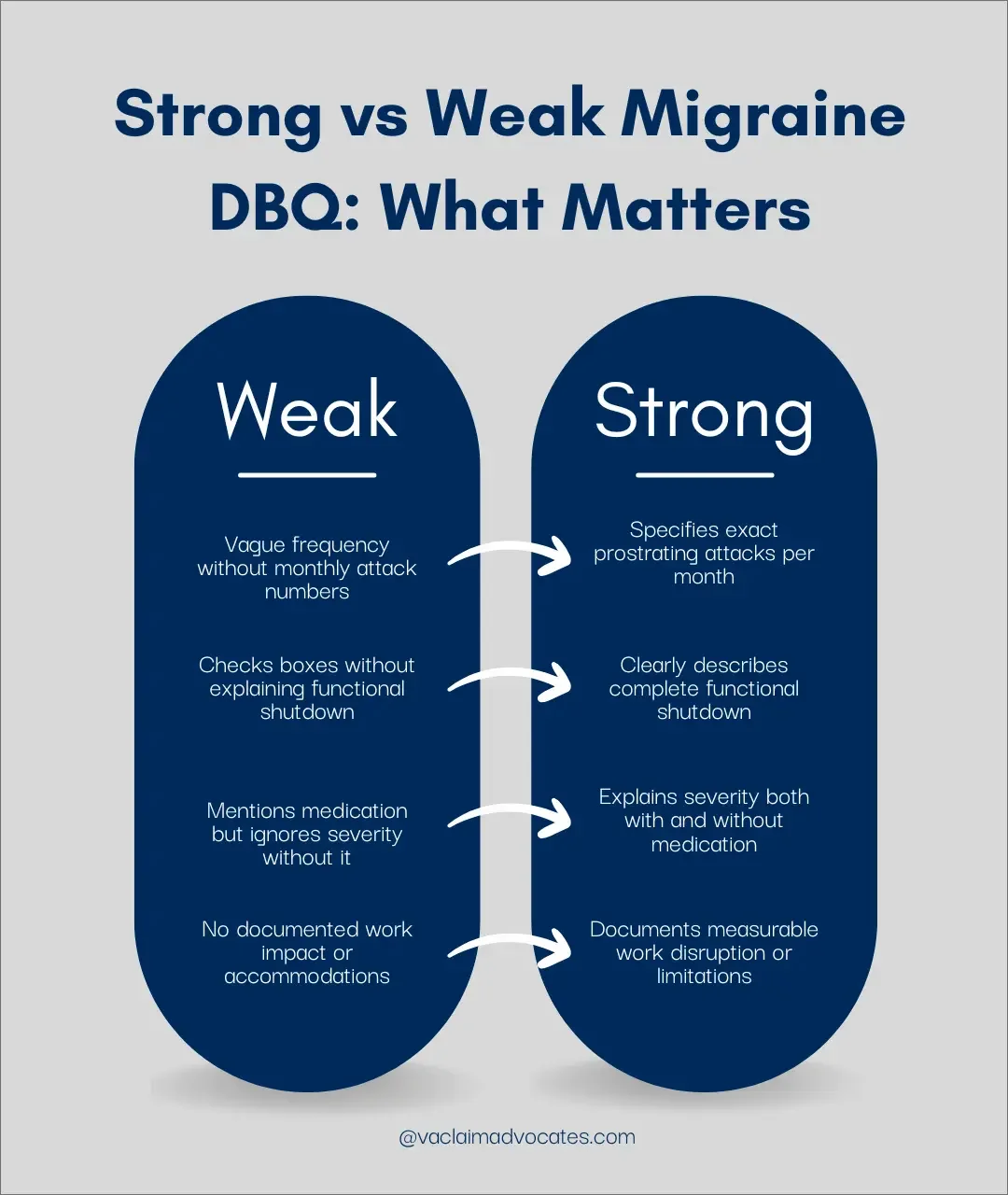
DBQs are powerful evidence in migraine claims when they align with your full record. They must clearly explain prostrating frequency and functional work impact, not just check severity boxes.
How VA Raters Review Migraine DBQs
When the VA evaluates a DBQ, it looks at whether the report makes sense in the context of your entire file, not just which boxes are checked
Raters compare the DBQ to:
Primary care and specialist notes
Medication history
Personal statements
Employer or buddy statements
If two parts of your file contradict each other, the VA will often discount both of them.
For example, if your DBQ says two prostrating attacks per month but your personal statement shows zero work impact or shutdown, the VA will amost certainly decide that those attacks weren’t prostrating.
What a Proper Migraine DBQ Must Include
This checklist outlines the specific elements a migraine DBQ should address to fully support a migraine rating and withstand review.
A Well-Supported Migraine DBQ Should Specify:
☐ Clear migraine diagnosis with documented features
(Establishes a medically recognized condition)
☐ Whether attacks are prostrating and how often they occur per month
(Frequency of prostrating attacks determines 0%, 10%, 30%, or 50% under DC 8100)
☐ Whether attacks are completely prostrating and prolonged, including duration
(Critical element for a 50% evaluation)
☐ Economic impact if applicable
(missed work, reduced hours, performance limits, accommodations)
☐ Medication history and severity without medication
(VA cannot reduce ratings solely because medication improves symptoms)
Why C&P Exams Lead to Low Ratings
C&P exams are notoriously inconsistent, yet they carry outsized weight in migraine ratings.
A huge percentage of low ratings, reductions, and denials trace back to a single exam that didn’t accurately capture what the veteran was experiencing.
What to Say at Your Migraine C&P Exam
When explaining migraines during a C&P exam, clarity matters more than intensity.
Focus on three things:
Frequency of prostrating attacks per month
Duration of each attack
How the attack disrupts work or daily function
You should clearly describe:
How often you must lie down
Whether you miss work or leave early
How long you remain unable to function
Whether medication still results in bedrest or shutdown
Medication relief does not eliminate a prostrating attack if you are still forced to stop normal activity.
The examiner’s job is to translate your description into rating criteria. Your job is to make that translation obvious.
Why Examiners Overlook Evidence
Many migraine C&P exams fail not because veterans lack evidence, but because the examiner does not fully connect that evidence to the rating criteria.
Examiners sometimes minimize or overlook:
Private DBQs
Personal statements
Buddy or lay statements
Employer documentation
Migraine logs
Higher-Level Reviews frequently overturn migraine decisions, especially when the evidence is solid and consistent.
Phrases That May Hurt Your Claim
Many negative C&P exam outcomes happen not because the migraines aren’t severe, but because the condition wasn’t described in the specific language the VA uses to assign ratings.
Veterans often say things like:
“I get really bad migraines.”
“I have flare-ups.”
“Some days are worse than others.”
“Medication usually helps.”
“I see a neurologist and tried Botox.”
The problem is that none those statements explain whether you experience prostrating attacks, they only talk about your symptoms.
How to Get Migraines Service Connected
Before the VA assigns a migraine rating under Diagnostic Code 8100, the condition must first be service connected.
Direct Service Connection for Migraines
Your migraines started in service or were caused by something that happened in service.
You need:
An in-service event (head injury, blast, toxic exposure, stress)
Headache symptoms in service (even if not diagnosed as migraines)
Ongoing symptoms after discharge
That’s it. Clear link from service → migraines today.
Secondary Service Connection for Migraines
Another service-connected condition causes or worsens your migraines.
Two ways this works:
Caused by → the condition directly produces migraines
Aggravated by → migraines existed but became worse because of it
Common secondary conditions:
PTSD / Anxiety
Tinnitus
Sleep apnea / insomnia
Neck or cervical spine issues
Most secondary VA claims require nexus letter explaining the connection.
PACT Act and Migraines Explained
The PACT Act has expanded VA benefits for many toxic exposure conditions, but it does not automatically grant service connection for migraines.
Migraines are not presumptive under the PACT Act.
Toxic exposure can still help prove an in-service event.
You still need medical evidence linking exposure to migraines.
The PACT Act can help establish exposure, but you still need medical evidence linking that exposure to your migraines to win the claim.
Final Thoughts on Migraine Ratings
Migraine ratings ultimately come down to how clearly your evidence shows the frequency of prostrating attacks and their impact on your ability to function and work.
Pain alone is not enough and relying on it soley is the reason many veterans are denied.
When your log, personal statement, buddy evidence, and DBQ all tell the same consistent story, your rating is far more likely to reflect the true severity of your condition.
FAQ
-
The most common VA disability rating for migraines is 30%. This rating reflects characteristic prostrating attacks occurring about once per month. VA neurological data shows 36% of conditions are rated at 10%, 11% at 30%, and only about 5% reach 50%, illustrating how higher ratings are less common overall.
-
C&P examiners summarize your statements rather than record them word for word, and they focus on translating symptoms into VA rating criteria. If something is described vaguely or omitted, it may not appear in the report. When that happens, it can sometimes be corrected through a Higher-Level Review.
-
A 0% migraine rating means the VA agrees your condition is service connected, but the evidence does not show prostrating attacks occurring often enough to meet compensable criteria. The VA does not rate migraines based on how miserable or painful they feel. It rates how often they force you to stop normal activity. If your records do not clearly show prostrating episodes averaging at least one every two months, the rating can remain at 0%.
-
To qualify for 50%, you must show very frequent, completely prostrating, and prolonged attacks that produce severe economic inadaptability. This generally means more than once per month on average over time, for example 12 prostrating attacks over 11 months. The attacks must significantly disrupt reliable work performance. Getting buddy or supervisor statements documenting how your prostrating episodes affect attendance and productivity is critical to connecting frequency to work impact.
-
A 30% rating requires prostrating attacks averaging once per month over several months. Your personal statement is key. Clearly explain the difference between bad migraines and true prostrating events that force you to stop activity. Emphasize how those episodes affect your ability to function, especially without medication, so the VA understands the full severity.